Technopedia Center
PMB University Brochure
Faculty of Engineering and Computer Science
S1 Informatics S1 Information Systems S1 Information Technology S1 Computer Engineering S1 Electrical Engineering S1 Civil Engineering

faculty of Economics and Business
S1 Management S1 Accountancy

Faculty of Letters and Educational Sciences
S1 English literature S1 English language education S1 Mathematics education S1 Sports Education
  • Registerasi
  • Brosur UTI
  • Kip Scholarship Information
  • Performance
  1. Weltenzyklopädie
  2. Modulare Funktion (harmonische Analyse) – Wikipedia
Modulare Funktion (harmonische Analyse) – Wikipedia 👆 Click Here!
aus Wikipedia, der freien Enzyklopädie
Unimodulare Gruppe ist eine Weiterleitung auf diesen Artikel. Für Gruppen von Matrizen mit Determinante 1 siehe spezielle lineare Gruppe.

Die modulare Funktion ist ein Begriff aus der harmonischen Analyse, das heißt aus der Theorie der lokalkompakten Gruppen. Die modulare Funktion misst eine Links-rechts-Asymmetrie der Gruppe.

Definition

[Bearbeiten | Quelltext bearbeiten]

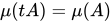
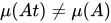
Es sei G {\displaystyle G} {\displaystyle G} eine lokalkompakte Gruppe. Dann gibt es bekanntlich ein linksinvariantes Haarsches Maß μ {\displaystyle \mu } {\displaystyle \mu } auf G {\displaystyle G} {\displaystyle G}. Linksinvarianz bedeutet dabei, dass μ ( t A ) = μ ( A ) {\displaystyle \mu (tA)=\mu (A)} {\displaystyle \mu (tA)=\mu (A)} für alle t ∈ G {\displaystyle t\in G} {\displaystyle t\in G} und alle Borelmengen A ⊂ G {\displaystyle A\subset G} {\displaystyle A\subset G}. Daraus folgt im Allgemeinen nicht, dass μ {\displaystyle \mu } {\displaystyle \mu } auch rechtsinvariant ist, das heißt, es kann durchaus μ ( A t ) ≠ μ ( A ) {\displaystyle \mu (At)\not =\mu (A)} {\displaystyle \mu (At)\not =\mu (A)} gelten.

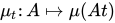
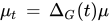
Für festes t ∈ G {\displaystyle t\in G} {\displaystyle t\in G} ist die Abbildung μ t : A ↦ μ ( A t ) {\displaystyle \mu _{t}\colon A\mapsto \mu (At)} {\displaystyle \mu _{t}\colon A\mapsto \mu (At)} ebenfalls ein linksinvariantes Haarsches Maß, wie man leicht bestätigen kann. Da ein solches bis auf eine Konstante eindeutig bestimmt ist, gibt es eine Zahl Δ G ( t ) ∈ R + {\displaystyle \Delta _{G}(t)\in \mathbb {R} ^{+}} {\displaystyle \Delta _{G}(t)\in \mathbb {R} ^{+}} mit μ t = Δ G ( t ) μ {\displaystyle \mu _{t}\,=\,\Delta _{G}(t)\mu } {\displaystyle \mu _{t}\,=\,\Delta _{G}(t)\mu }, das heißt μ ( A t ) = Δ G ( t ) μ ( A ) {\displaystyle \mu (At)\,=\,\Delta _{G}(t)\mu (A)} {\displaystyle \mu (At)\,=\,\Delta _{G}(t)\mu (A)} für alle messbaren A ⊂ G {\displaystyle A\subset G} {\displaystyle A\subset G}.

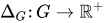
Auf diese Weise erhält man eine Abbildung Δ G : G → R + {\displaystyle \Delta _{G}\colon G\rightarrow \mathbb {R} ^{+}} {\displaystyle \Delta _{G}\colon G\rightarrow \mathbb {R} ^{+}}, die sich als unabhängig von der Wahl des linksinvarianten Haarschen Maßes μ {\displaystyle \mu } {\displaystyle \mu } erweist und ein stetiger Homomorphismus von G {\displaystyle G} {\displaystyle G} in die multiplikative Gruppe R + {\displaystyle \mathbb {R} ^{+}} {\displaystyle \mathbb {R} ^{+}} ist.[1] Δ G {\displaystyle \Delta _{G}} {\displaystyle \Delta _{G}} heißt die modulare Funktion von G {\displaystyle G} {\displaystyle G}

Unimodulare Gruppen

[Bearbeiten | Quelltext bearbeiten]

Gruppen, für die die modulare Funktion gleich der konstanten Funktion Δ G ( t ) = 1 {\displaystyle \Delta _{G}(t)=1} {\displaystyle \Delta _{G}(t)=1} für alle t ∈ G {\displaystyle t\in G} {\displaystyle t\in G} ist, nennt man unimodular. Das sind genau diejenigen Gruppen, für die ein linksinvariantes Haarsches Maß auch rechtsinvariant ist. Drei wichtige Typen lokalkompakter Gruppen sind automatisch unimodular:

  • Kommutative lokalkompakte Gruppen sind unimodular, denn wegen der Kommutativität sind linksinvariante Maße natürlich auch rechtsinvariant.
  • Kompakte Gruppen sind unimodular, denn das Bild der modularen Funktion muss eine kompakte Untergruppe in R + {\displaystyle \mathbb {R} ^{+}} {\displaystyle \mathbb {R} ^{+}} sein, und da kommt nur { 1 } {\displaystyle \{1\}} {\displaystyle \{1\}} in Frage.
  • Diskrete Gruppen sind unimodular, denn die Vielfachen des Zählmaßes sind genau die links- und rechtsinvarianten Haarschen Maße.

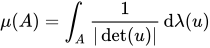
Ein Beispiel für eine unimodulare, lokalkompakte Gruppe, die unter keinen dieser drei Typen fällt, ist die allgemeine lineare Gruppe G L ( n , R ) {\displaystyle GL(n,\mathbb {R} )} {\displaystyle GL(n,\mathbb {R} )}. Ein links- und rechts-invariantes Maß ist durch

μ ( A ) = ∫ A 1 | det ( u ) | d λ ( u ) {\displaystyle \mu (A)=\int _{A}{\frac {1}{|\det(u)|}}\,\mathrm {d} \lambda (u)} {\displaystyle \mu (A)=\int _{A}{\frac {1}{|\det(u)|}}\,\mathrm {d} \lambda (u)}

gegeben, wobei λ {\displaystyle \lambda } {\displaystyle \lambda } das Lebesguemaß auf R n 2 {\displaystyle \mathbb {R} ^{n^{2}}} {\displaystyle \mathbb {R} ^{n^{2}}} ist.

Beispiel

[Bearbeiten | Quelltext bearbeiten]

Wir geben hier ein Beispiel für eine nicht-triviale modulare Funktion. Es sei G {\displaystyle G} {\displaystyle G} die lokalkompakte Gruppe aller 2 × 2 {\displaystyle 2\times 2} {\displaystyle 2\times 2}-Matrizen

( a b 0 1 ) {\displaystyle {\begin{pmatrix}a&b\\0&1\end{pmatrix}}} {\displaystyle {\begin{pmatrix}a&b\\0&1\end{pmatrix}}}

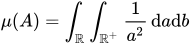
mit a , b ∈ R , a > 0 {\displaystyle a,b\in \mathbb {R} ,a>0} {\displaystyle a,b\in \mathbb {R} ,a>0}. Ein links-invariantes Haarsches Maß ist durch

μ ( A ) = ∫ R ∫ R + 1 a 2 d a d b {\displaystyle \mu (A)=\int _{\mathbb {R} }\int _{\mathbb {R} ^{+}}{\frac {1}{a^{2}}}\,\mathrm {d} a\mathrm {d} b} {\displaystyle \mu (A)=\int _{\mathbb {R} }\int _{\mathbb {R} ^{+}}{\frac {1}{a^{2}}}\,\mathrm {d} a\mathrm {d} b}

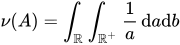
gegeben, ein rechtsinvariantes durch

ν ( A ) = ∫ R ∫ R + 1 a d a d b {\displaystyle \nu (A)=\int _{\mathbb {R} }\int _{\mathbb {R} ^{+}}{\frac {1}{a}}\,\mathrm {d} a\mathrm {d} b} {\displaystyle \nu (A)=\int _{\mathbb {R} }\int _{\mathbb {R} ^{+}}{\frac {1}{a}}\,\mathrm {d} a\mathrm {d} b}.

Damit ergibt sich[2]

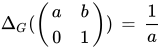
Δ G ( ( a b 0 1 ) ) = 1 a {\displaystyle \Delta _{G}({\begin{pmatrix}a&b\\0&1\end{pmatrix}})\,=\,{\frac {1}{a}}} {\displaystyle \Delta _{G}({\begin{pmatrix}a&b\\0&1\end{pmatrix}})\,=\,{\frac {1}{a}}}.

Rechenregeln

[Bearbeiten | Quelltext bearbeiten]

Es sei G {\displaystyle G} {\displaystyle G} eine lokalkompakte Gruppe mit linksinvariantem Haarschen Maß μ {\displaystyle \mu } {\displaystyle \mu }. Für eine Funktion f : G → R {\displaystyle f\colon G\rightarrow R} {\displaystyle f\colon G\rightarrow R} sei f s ( t ) := f ( t s − 1 ) {\displaystyle f_{s}(t)\,:=\,f(ts^{-1})} {\displaystyle f_{s}(t)\,:=\,f(ts^{-1})}, die sogenannte Translation von f {\displaystyle f} {\displaystyle f} um s {\displaystyle s} {\displaystyle s}.

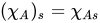
Ist χ A {\displaystyle \chi _{A}} {\displaystyle \chi _{A}} die charakteristische Funktion der Borelmenge A {\displaystyle A} {\displaystyle A}, so ist ( χ A ) s = χ A s {\displaystyle (\chi _{A})_{s}=\chi _{As}} {\displaystyle (\chi _{A})_{s}=\chi _{As}} und daher nach Konstruktion der modularen Funktion

∫ ( χ A ) s ( t ) d μ ( t ) = ∫ χ A s ( t ) d μ ( t ) = μ ( A s ) = Δ G ( s ) μ ( A ) = Δ G ( s ) ∫ χ A ( t ) d μ ( t ) {\displaystyle \int (\chi _{A})_{s}(t)\mathrm {d} \mu (t)=\int \chi _{As}(t)\mathrm {d} \mu (t)=\mu (As)=\Delta _{G}(s)\mu (A)=\Delta _{G}(s)\int \chi _{A}(t)\mathrm {d} \mu (t)} {\displaystyle \int (\chi _{A})_{s}(t)\mathrm {d} \mu (t)=\int \chi _{As}(t)\mathrm {d} \mu (t)=\mu (As)=\Delta _{G}(s)\mu (A)=\Delta _{G}(s)\int \chi _{A}(t)\mathrm {d} \mu (t)}.

Mit den üblichen maßtheoretischen Schlüssen erhält man daraus für jede μ {\displaystyle \mu } {\displaystyle \mu }-integrierbare Funktion f {\displaystyle f} {\displaystyle f}:[3]

∫ f s ( t ) d μ ( t ) = Δ G ( s ) ∫ f ( t ) d μ ( t ) {\displaystyle \int f_{s}(t)\mathrm {d} \mu (t)=\Delta _{G}(s)\int f(t)\mathrm {d} \mu (t)} {\displaystyle \int f_{s}(t)\mathrm {d} \mu (t)=\Delta _{G}(s)\int f(t)\mathrm {d} \mu (t)}.

Weiter tritt die modulare Funktion auf, wenn man über invertierte Argumente integriert. Für μ {\displaystyle \mu } {\displaystyle \mu }-integrierbare Funktionen f {\displaystyle f} {\displaystyle f} auf G {\displaystyle G} {\displaystyle G} gilt[4]

∫ f ( t − 1 ) Δ G ( t − 1 ) d μ ( t ) = ∫ f ( t ) d μ ( t ) {\displaystyle \int f(t^{-1})\Delta _{G}(t^{-1})\mathrm {d} \mu (t)\,=\,\int f(t)\mathrm {d} \mu (t)} {\displaystyle \int f(t^{-1})\Delta _{G}(t^{-1})\mathrm {d} \mu (t)\,=\,\int f(t)\mathrm {d} \mu (t)}.

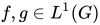
Schließlich kommt die modulare Funktion in der Definition der Involution auf der Faltungsalgebra L 1 ( G ) {\displaystyle L^{1}(G)} {\displaystyle L^{1}(G)} vor. Auf dem L 1 {\displaystyle L^{1}} {\displaystyle L^{1}}-Raum über ( G , μ ) {\displaystyle (G,\mu )} {\displaystyle (G,\mu )} definiere man für Funktionen f , g ∈ L 1 ( G ) {\displaystyle f,g\in L^{1}(G)} {\displaystyle f,g\in L^{1}(G)}

f ⋆ g ( t ) := ∫ f ( s ) g ( s − 1 t ) d μ ( s ) {\displaystyle f\star g(t)\,:=\int f(s)g(s^{-1}t)\mathrm {d} \mu (s)} {\displaystyle f\star g(t)\,:=\int f(s)g(s^{-1}t)\mathrm {d} \mu (s)}
f ∗ ( t ) := Δ G ( t − 1 ) f ( t − 1 ) ¯ {\displaystyle f^{*}(t):=\Delta _{G}(t^{-1}){\overline {f(t^{-1})}}} {\displaystyle f^{*}(t):=\Delta _{G}(t^{-1}){\overline {f(t^{-1})}}}.

Dabei ist f ⋆ g {\displaystyle f\star g} {\displaystyle f\star g} nur fast überall definiert, nämlich dort, wo das Integral existiert, und der Querstrich steht für die komplexe Konjugation. Mit dem durch ⋆ {\displaystyle \star } {\displaystyle \star } definierten sogenannten Faltungsprodukt und der Abbildung f ↦ f ∗ {\displaystyle f\mapsto f^{*}} {\displaystyle f\mapsto f^{*}} wird L 1 ( G ) {\displaystyle L^{1}(G)} {\displaystyle L^{1}(G)} zu einer Banachalgebra mit isometrischer Involution.[5] Die Untersuchung dieser Banachalgebra ist ein wichtiges Instrument der harmonischen Analyse.

Einzelnachweise

[Bearbeiten | Quelltext bearbeiten]
  1. ↑ Donald L. Cohn: Measure Theory. Birkhäuser, Boston MA 1980, ISBN 3-7643-3003-1, Satz 9.3.4.
  2. ↑ Donald L. Cohn: Measure Theory. Birkhäuser, Boston MA 1980, ISBN 3-7643-3003-1, Kapitel 9.3, Übung 2
  3. ↑ Donald L. Cohn: Measure Theory. Birkhäuser, Boston MA 1980, ISBN 3-7643-3003-1, Text nach Satz 9.3.3.
  4. ↑ Lynn H. Loomis: An Introduction to Abstract Harmonic Analysis. D. van Nostrand Co., Princeton NJ u. a. 1953, § 30B.
  5. ↑ Jacques Dixmier: C*-algebras (= North-Holland Mathematical Library. Bd. 15). North Holland Publishing Company, Amsterdam u. a. 1977, ISBN 0-7204-2450-X, Kapitel 13.2.
Abgerufen von „https://de.teknopedia.teknokrat.ac.id/w/index.php?title=Modulare_Funktion_(harmonische_Analyse)&oldid=221263964“
Kategorien:
  • Maßtheorie
  • Harmonische Analyse

  • indonesia
  • Polski
  • العربية
  • Deutsch
  • English
  • Español
  • Français
  • Italiano
  • مصرى
  • Nederlands
  • 日本語
  • Português
  • Sinugboanong Binisaya
  • Svenska
  • Українська
  • Tiếng Việt
  • Winaray
  • 中文
  • Русский
Sunting pranala
Pusat Layanan

UNIVERSITAS TEKNOKRAT INDONESIA | ASEAN's Best Private University
Jl. ZA. Pagar Alam No.9 -11, Labuhan Ratu, Kec. Kedaton, Kota Bandar Lampung, Lampung 35132
Phone: (0721) 702022
Email: pmb@teknokrat.ac.id