Die Digamma-Funktion
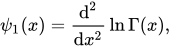
ψ
(
x
)
{\displaystyle \psi (x)}
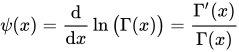
komplexen Zahlenebene . Die Digamma-Funktion oder Psi-Funktion ist in der Mathematik eine Funktion , die definiert wird als:
ψ
(
x
)
=
d
d
x
ln
(
Γ
(
x
)
)
=
Γ
′
(
x
)
Γ
(
x
)
{\displaystyle \psi (x)={\frac {\mathrm {d} }{\mathrm {d} x}}\ln {\big (}\Gamma (x){\big )}={\frac {\Gamma '(x)}{\Gamma (x)}}}
Sie ist also die logarithmische Ableitung der Gammafunktion . Die Digamma-Funktion ist die erste der Polygammafunktionen . Bis auf ihre Pole erster Ordnung für nicht positive ganze Argumente ist sie (genau wie die Gammafunktion) in ganz
C
{\displaystyle \mathbb {C} }
holomorph .
Die Digammafunktion, welche meist als ψ 0 (x ), ψ 0 (x ) oder
ϝ
{\displaystyle \digamma }
digamma ) dargestellt wird, steht für ganzzahlige Werte mit der harmonischen Reihe in folgender Beziehung:
ψ
(
n
)
=
H
n
−
1
−
γ
{\displaystyle \psi (n)=H_{n-1}-\gamma }
wobei H n n -te Element der harmonischen Reihe und
γ
{\displaystyle \gamma }
Euler-Mascheroni-Konstante ist. Für halbzahlige Werte kann sie geschrieben werden als:
ψ
(
n
+
1
2
)
=
−
γ
−
2
ln
2
+
∑
k
=
1
n
2
2
k
−
1
.
{\displaystyle \psi \left(n+{\frac {1}{2}}\right)=-\gamma -2\ln 2+\sum _{k=1}^{n}{\frac {2}{2k-1}}.}
Die Digammafunktion kann wie folgt als Integral dargestellt werden:
ψ
(
x
)
=
∫
0
∞
(
e
−
t
t
−
e
−
x
t
1
−
e
−
t
)
d
t
{\displaystyle \psi (x)=\int _{0}^{\infty }\left({\frac {e^{-t}}{t}}-{\frac {e^{-xt}}{1-e^{-t}}}\right)\,\mathrm {d} t}
Für alle positiven x-Werte gilt diese Formel:
ψ
(
x
)
=
ln
(
x
)
−
1
2
x
−
∫
0
∞
2
y
(
y
2
+
1
)
[
exp
(
2
π
x
y
)
−
1
]
d
y
{\displaystyle \psi (x)=\ln(x)-{\frac {1}{2x}}-\int _{0}^{\infty }{\frac {2y}{(y^{2}+1)[\exp(2\pi xy)-1]}}\mathrm {d} y}
Diese Formel resultiert aus der Abel-Plana-Summenformel und geht durch die Mellin-Transformation hervor.
Dies kann auch geschrieben werden als:
ψ
(
s
+
1
)
=
−
γ
+
∫
0
1
1
−
x
s
1
−
x
d
x
{\displaystyle \psi (s+1)=-\gamma +\int _{0}^{1}{\frac {1-x^{s}}{1-x}}\,\mathrm {d} x}
Dies folgt aus der Formel für das Euler-Integral für die harmonische Reihe.
Durch Reihenentwicklung der Taylor-Reihe um den Punkt z =1 kann die Digammafunktion wie folgt dargestellt werden:
ψ
(
z
+
1
)
=
−
γ
−
∑
k
=
1
∞
ζ
(
k
+
1
)
(
−
z
)
k
.
{\displaystyle \psi (z+1)=-\gamma -\sum _{k=1}^{\infty }\zeta (k+1)\;(-z)^{k}.}
Sie konvergiert für |z |<1. Dabei ist
ζ
(
n
)
{\displaystyle \zeta (n)}
Riemannsche ζ-Funktion . Die Reihe kann leicht von der zugehörigen Taylor-Reihe für die Hurwitzsche ζ-Funktion hergeleitet werden.
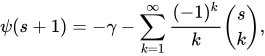
Die binomische Reihe für die Digammafunktion folgt aus dem Euler-Integral
ψ
(
s
+
1
)
=
−
γ
−
∑
k
=
1
∞
(
−
1
)
k
k
(
s
k
)
,
{\displaystyle \psi (s+1)=-\gamma -\sum _{k=1}^{\infty }{\frac {(-1)^{k}}{k}}{s \choose k},}
wobei
(
s
k
)
{\displaystyle {\tbinom {s}{k}}}
verallgemeinerte Binomialkoeffizient ist.
Die Digammafunktion genügt folgender Funktionalgleichung , welche direkt aus der logarithmischen Ableitung der Gammafunktion hergeleitet werden kann:
ψ
(
1
−
x
)
−
ψ
(
x
)
=
π
cot
(
π
x
)
.
{\displaystyle \psi (1-x)-\psi (x)=\pi \cot {\left(\pi x\right)}.}
Hiermit kann allerdings nicht ψ(1/2) berechnet werden; dieser Wert ist unten angegeben.
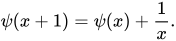
Die Digamma-Funktion genügt der Rekursionsformel
ψ
(
x
+
1
)
=
ψ
(
x
)
+
1
x
.
{\displaystyle \psi (x+1)=\psi (x)+{\frac {1}{x}}.}
oder
Δ
[
ψ
]
(
x
)
=
1
x
,
{\displaystyle \Delta [\psi ](x)={\frac {1}{x}},}
wobei Δ der rechtsseitige Differenzoperator ist. Dies erfüllt die Rekursionsbeziehung der harmonischen Reihe . Daraus folgt
ψ
(
n
)
=
H
n
−
1
−
γ
.
{\displaystyle \psi (n)\ =\ H_{n-1}-\gamma .}
Allgemeiner gilt:
ψ
(
x
)
=
−
γ
+
∑
k
=
1
∞
(
1
k
−
1
x
+
k
−
1
)
.
{\displaystyle \psi (x)=-\gamma +\sum _{k=1}^{\infty }\left({\frac {1}{k}}-{\frac {1}{x+k-1}}\right).}
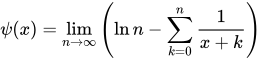
Aus der Gaußschen Produktdarstellung der Gammafunktion lässt sich äquivalent dazu
ψ
(
x
)
=
lim
n
→
∞
(
ln
n
−
∑
k
=
0
n
1
x
+
k
)
{\displaystyle \psi (x)=\lim \limits _{n\to \infty }\left(\ln n-\sum \limits _{k=0}^{n}{\frac {1}{x+k}}\right)}
schlussfolgern.
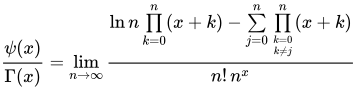
Für den Quotienten aus Digammafunktion und Gammafunktion liefert die Produktdarstellung den Ausdruck
ψ
(
x
)
Γ
(
x
)
=
lim
n
→
∞
ln
n
∏
k
=
0
n
(
x
+
k
)
−
∑
j
=
0
n
∏
k
=
0
k
≠
j
n
(
x
+
k
)
n
!
n
x
{\displaystyle {\frac {\psi (x)}{\Gamma (x)}}=\lim \limits _{n\to \infty }{\frac {\ln n\prod \limits _{k=0}^{n}(x+k)-\sum \limits _{j=0}^{n}\prod \limits _{k=0 \atop k\neq j}^{n}(x+k)}{n!\,n^{x}}}}
Bei positiven ganzen Zahlen
m
≥
0
{\displaystyle m\geq 0}
ψ
(
−
m
)
Γ
(
−
m
)
=
−
lim
n
→
∞
∏
k
=
0
k
≠
m
n
(
k
−
m
)
n
!
n
−
m
=
(
−
1
)
m
−
1
m
!
lim
n
→
∞
n
m
∏
k
=
n
−
m
+
1
n
k
=
(
−
1
)
m
−
1
m
!
{\displaystyle {\frac {\psi (-m)}{\Gamma (-m)}}=-\lim \limits _{n\to \infty }{\frac {\prod \limits _{k=0 \atop k\neq m}^{n}(k-m)}{n!\,n^{-m}}}=(-1)^{m-1}m!\lim \limits _{n\to \infty }{\frac {n^{m}}{\prod \limits _{k=n-m+1}^{n}k}}=(-1)^{m-1}m!}
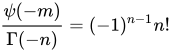
Mit Hilfe der Funktionalgleichung für die Gammafunktion findet man sogar heraus, dass der Wert des Quotienten ausschließlich vom
Argument der Gammafunktion abhängt, also gilt für ganzzahlige
m
,
n
≥
0
{\displaystyle m,n\geq 0}
ψ
(
−
m
)
Γ
(
−
n
)
=
(
−
1
)
n
−
1
n
!
{\displaystyle {\frac {\psi (-m)}{\Gamma (-n)}}=(-1)^{n-1}n!}
Die Digammafunktion hat eine Gaußsche Summe der Form
−
1
π
k
∑
n
=
1
k
sin
2
π
n
m
k
ψ
(
n
k
)
=
ζ
(
0
,
m
k
)
=
−
B
1
(
m
k
)
=
1
2
−
m
k
{\displaystyle -{\frac {1}{\pi k}}\sum _{n=1}^{k}\sin {\frac {2\pi nm}{k}}\,\psi \left({\frac {n}{k}}\right)=\zeta \left(0,{\frac {m}{k}}\right)=-\mathrm {B} _{1}\left({\frac {m}{k}}\right)={\frac {1}{2}}-{\frac {m}{k}}}
für natürliche Zahlen
0
<
m
<
k
{\displaystyle 0<m<k}
s ,q ) die Hurwitzsche ζ-Funktion und
B
n
(
x
)
{\displaystyle \mathrm {B} _{n}(x)}
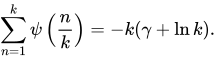
Bernoulli-Polynom . Ein Spezialfall des Multiplikationstheorem ist
∑
n
=
1
k
ψ
(
n
k
)
=
−
k
(
γ
+
ln
k
)
.
{\displaystyle \sum _{n=1}^{k}\psi \left({\frac {n}{k}}\right)=-k(\gamma +\ln k).}
Für ganze Zahlen
m
{\displaystyle m}
k
{\displaystyle k}
m
<
k
{\displaystyle m<k}
elementaren Funktionen ausgedrückt werden
ψ
(
m
k
)
=
−
γ
−
ln
(
2
k
)
−
π
2
cot
m
π
k
+
2
∑
n
=
1
[
k
−
1
2
]
cos
2
π
n
m
k
ln
sin
n
π
k
.
{\displaystyle \psi \left({\frac {m}{k}}\right)=-\gamma -\ln(2k)-{\frac {\pi }{2}}\cot {\frac {m\pi }{k}}+2\sum _{n=1}^{\left[{\frac {k-1}{2}}\right]}\cos {\frac {2\pi nm}{k}}\,\ln \sin {\frac {n\pi }{k}}.}
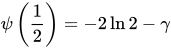
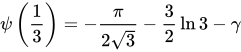
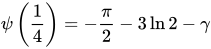
Die Digamma-Funktion hat unter anderem folgende besondere Werte:
ψ
(
1
)
=
−
γ
{\displaystyle \psi \,(1)=-\gamma }
ψ
(
1
2
)
=
−
2
ln
2
−
γ
{\displaystyle \psi \left({\frac {1}{2}}\right)=-2\ln 2-\gamma }
ψ
(
1
3
)
=
−
π
2
3
−
3
2
ln
3
−
γ
{\displaystyle \psi \left({\frac {1}{3}}\right)=-{\frac {\pi }{2{\sqrt {3}}}}-{\frac {3}{2}}\ln 3-\gamma }
ψ
(
1
4
)
=
−
π
2
−
3
ln
2
−
γ
{\displaystyle \psi \left({\frac {1}{4}}\right)=-{\frac {\pi }{2}}-3\ln 2-\gamma }
ψ
(
1
6
)
=
−
π
2
3
−
2
ln
2
−
3
2
ln
3
−
γ
{\displaystyle \psi \left({\frac {1}{6}}\right)=-{\frac {\pi }{2}}{\sqrt {3}}-2\ln 2-{\frac {3}{2}}\ln 3-\gamma }
Nach der oben abgebildeten Formel gilt:
ψ
(
1
)
=
−
∫
0
∞
1
exp
(
x
)
−
1
−
1
x
exp
(
x
)
d
x
{\displaystyle \psi (1)=-\int _{0}^{\infty }{\frac {1}{\exp(x)-1}}-{\frac {1}{x\exp(x)}}\mathrm {d} x}
Dieses Integral lässt sich so umformen:
∫
0
∞
1
exp
(
x
)
−
1
−
1
x
exp
(
x
)
d
x
=
∫
0
∞
exp
(
−
x
)
+
x
−
1
x
[
exp
(
x
)
−
1
]
d
x
=
∫
0
∞
1
x
[
exp
(
x
)
−
1
]
∑
m
=
1
∞
(
−
1
)
m
+
1
x
m
+
1
(
m
+
1
)
!
d
x
=
{\displaystyle \int _{0}^{\infty }{\frac {1}{\exp(x)-1}}-{\frac {1}{x\exp(x)}}\mathrm {d} x=\int _{0}^{\infty }{\frac {\exp(-x)+x-1}{x[\exp(x)-1]}}\mathrm {d} x=\int _{0}^{\infty }{\frac {1}{x[\exp(x)-1]}}\sum _{m=1}^{\infty }{\frac {(-1)^{m+1}x^{m+1}}{(m+1)!}}\mathrm {d} x=}
=
∫
0
∞
∑
m
=
1
∞
(
−
1
)
m
+
1
x
m
(
m
+
1
)
!
[
exp
(
x
)
−
1
]
d
x
=
∑
m
=
1
∞
∫
0
∞
(
−
1
)
m
+
1
x
m
(
m
+
1
)
!
[
exp
(
x
)
−
1
]
d
x
=
{\displaystyle =\int _{0}^{\infty }\sum _{m=1}^{\infty }{\frac {(-1)^{m+1}x^{m}}{(m+1)![\exp(x)-1]}}\mathrm {d} x=\sum _{m=1}^{\infty }\int _{0}^{\infty }{\frac {(-1)^{m+1}x^{m}}{(m+1)![\exp(x)-1]}}\mathrm {d} x=}
=
∑
m
=
1
∞
(
−
1
)
m
+
1
(
m
+
1
)
!
∫
0
∞
x
m
exp
(
x
)
−
1
d
x
=
∑
m
=
1
∞
(
−
1
)
m
+
1
(
m
+
1
)
!
m
!
ζ
(
m
+
1
)
=
∑
m
=
1
∞
(
−
1
)
m
+
1
m
+
1
ζ
(
m
+
1
)
=
{\displaystyle =\sum _{m=1}^{\infty }{\frac {(-1)^{m+1}}{(m+1)!}}\int _{0}^{\infty }{\frac {x^{m}}{\exp(x)-1}}\mathrm {d} x=\sum _{m=1}^{\infty }{\frac {(-1)^{m+1}}{(m+1)!}}m!\zeta (m+1)=\sum _{m=1}^{\infty }{\frac {(-1)^{m+1}}{m+1}}\zeta (m+1)=}
=
∑
m
=
1
∞
(
−
1
)
m
+
1
m
+
1
∑
n
=
1
∞
1
n
m
+
1
=
∑
m
=
1
∞
∑
n
=
1
∞
(
−
1
)
m
+
1
m
+
1
1
n
m
+
1
=
∑
n
=
1
∞
∑
m
=
1
∞
(
−
1
)
m
+
1
m
+
1
1
n
m
+
1
=
{\displaystyle =\sum _{m=1}^{\infty }{\frac {(-1)^{m+1}}{m+1}}\sum _{n=1}^{\infty }{\frac {1}{n^{m+1}}}=\sum _{m=1}^{\infty }\sum _{n=1}^{\infty }{\frac {(-1)^{m+1}}{m+1}}{\frac {1}{n^{m+1}}}=\sum _{n=1}^{\infty }\sum _{m=1}^{\infty }{\frac {(-1)^{m+1}}{m+1}}{\frac {1}{n^{m+1}}}=}
=
∑
n
=
1
∞
1
n
+
Li
1
(
−
1
n
)
=
∑
n
=
1
∞
1
n
−
ln
(
1
+
1
n
)
=
γ
{\displaystyle =\sum _{n=1}^{\infty }{\frac {1}{n}}+\operatorname {Li} _{1}\left(-{\frac {1}{n}}\right)=\sum _{n=1}^{\infty }{\frac {1}{n}}-\ln \left(1+{\frac {1}{n}}\right)=\gamma }
Deswegen nimmt ψ(1) den Wert -γ an.
In der dritten Zeile der Gleichungskette wird der Debyesche Funktionswert von Plus Unendlich genannt, welcher aus der Geometrischen Reihe hervorgeht.
Am Ende der vierten Zeile taucht die Maclaurinsche Reihe des Monologarithmus auf, welche als Stammfunktion der Geometrischen Reihe hervorgeht.
Aus der Beziehung zur harmonischen Reihe resultiert diese für alle z ∈ ℕ gültige Formel:
ψ
(
1
z
+
1
)
=
−
γ
−
(
z
+
1
)
∫
0
1
1
−
x
z
1
−
x
z
+
1
d
x
{\displaystyle \psi \left({\frac {1}{z+1}}\right)=-\gamma -(z+1)\int _{0}^{1}{\frac {1-x^{z}}{1-x^{z+1}}}\mathrm {d} x}
Also gilt:
ψ
(
1
2
)
=
−
γ
−
2
∫
0
1
1
−
x
1
−
x
2
d
x
=
−
γ
−
2
∫
0
1
1
1
+
x
d
x
=
−
γ
−
2
∫
0
1
d
d
x
ln
(
x
+
1
)
d
x
=
−
γ
−
2
ln
(
2
)
{\displaystyle \psi \left({\frac {1}{2}}\right)=-\gamma -2\int _{0}^{1}{\frac {1-x}{1-x^{2}}}\mathrm {d} x=-\gamma -2\int _{0}^{1}{\frac {1}{1+x}}\mathrm {d} x=-\gamma -2\int _{0}^{1}{\frac {\mathrm {d} }{\mathrm {d} x}}\ln(x+1)\mathrm {d} x=-\gamma -2\ln(2)}
ψ
(
1
3
)
=
−
γ
−
3
∫
0
1
1
−
x
2
1
−
x
3
d
x
=
−
γ
−
3
∫
0
1
1
+
x
1
+
x
+
x
2
d
x
=
{\displaystyle \psi \left({\frac {1}{3}}\right)=-\gamma -3\int _{0}^{1}{\frac {1-x^{2}}{1-x^{3}}}\mathrm {d} x=-\gamma -3\int _{0}^{1}{\frac {1+x}{1+x+x^{2}}}\mathrm {d} x=}
=
−
γ
−
3
∫
0
1
d
d
x
1
3
3
arctan
[
1
3
3
(
1
+
2
x
)
]
+
1
2
ln
(
1
+
x
+
x
2
)
d
x
=
−
γ
−
1
6
3
π
−
3
2
ln
(
3
)
{\displaystyle =-\gamma -3\int _{0}^{1}{\frac {\mathrm {d} }{\mathrm {d} x}}{\frac {1}{3}}{\sqrt {3}}\arctan \left[{\frac {1}{3}}{\sqrt {3}}(1+2x)\right]+{\frac {1}{2}}\ln(1+x+x^{2})\mathrm {d} x=-\gamma -{\frac {1}{6}}{\sqrt {3}}\pi -{\frac {3}{2}}\ln(3)}
Die Ableitung der Digammafunktion ist nach deren Definition die Trigamma-Funktion
ψ
1
(
x
)
=
d
2
d
x
2
ln
Γ
(
x
)
,
{\displaystyle \psi _{1}(x)={\frac {\mathrm {d} ^{2}}{\mathrm {d} x^{2}}}\ln \Gamma (x),}
die zweite Polygammafunktion .








![{\displaystyle \psi (x)=\ln(x)-{\frac {1}{2x}}-\int _{0}^{\infty }{\frac {2y}{(y^{2}+1)[\exp(2\pi xy)-1]}}\mathrm {d} y}](https://wikimedia.org/api/rest_v1/media/math/render/svg/4b762948cf0e924d926b25db80b37ad88b1ebadd)





={\frac {1}{x}},}](https://wikimedia.org/api/rest_v1/media/math/render/svg/bf842f79ef86f1960dd0121020b68ff4cf7be18c)










![{\displaystyle \psi \left({\frac {m}{k}}\right)=-\gamma -\ln(2k)-{\frac {\pi }{2}}\cot {\frac {m\pi }{k}}+2\sum _{n=1}^{\left[{\frac {k-1}{2}}\right]}\cos {\frac {2\pi nm}{k}}\,\ln \sin {\frac {n\pi }{k}}.}](https://wikimedia.org/api/rest_v1/media/math/render/svg/fa353aad7f3aedc0f9927efb5481f73bfc62b8ee)



![{\displaystyle \int _{0}^{\infty }{\frac {1}{\exp(x)-1}}-{\frac {1}{x\exp(x)}}\mathrm {d} x=\int _{0}^{\infty }{\frac {\exp(-x)+x-1}{x[\exp(x)-1]}}\mathrm {d} x=\int _{0}^{\infty }{\frac {1}{x[\exp(x)-1]}}\sum _{m=1}^{\infty }{\frac {(-1)^{m+1}x^{m+1}}{(m+1)!}}\mathrm {d} x=}](https://wikimedia.org/api/rest_v1/media/math/render/svg/aaec153e3de3ca77435a95790b4e3d5db3a41dfe)
![{\displaystyle =\int _{0}^{\infty }\sum _{m=1}^{\infty }{\frac {(-1)^{m+1}x^{m}}{(m+1)![\exp(x)-1]}}\mathrm {d} x=\sum _{m=1}^{\infty }\int _{0}^{\infty }{\frac {(-1)^{m+1}x^{m}}{(m+1)![\exp(x)-1]}}\mathrm {d} x=}](https://wikimedia.org/api/rest_v1/media/math/render/svg/c5a564b4397b1737a6d1c751bb7cc7c18f8453f4)






![{\displaystyle =-\gamma -3\int _{0}^{1}{\frac {\mathrm {d} }{\mathrm {d} x}}{\frac {1}{3}}{\sqrt {3}}\arctan \left[{\frac {1}{3}}{\sqrt {3}}(1+2x)\right]+{\frac {1}{2}}\ln(1+x+x^{2})\mathrm {d} x=-\gamma -{\frac {1}{6}}{\sqrt {3}}\pi -{\frac {3}{2}}\ln(3)}](https://wikimedia.org/api/rest_v1/media/math/render/svg/c7430ebb77b0824fc37f2ae76ae5e4f0bc954cb5)