Technopedia Center
PMB University Brochure
Faculty of Engineering and Computer Science
S1 Informatics S1 Information Systems S1 Information Technology S1 Computer Engineering S1 Electrical Engineering S1 Civil Engineering

faculty of Economics and Business
S1 Management S1 Accountancy

Faculty of Letters and Educational Sciences
S1 English literature S1 English language education S1 Mathematics education S1 Sports Education
  • Registerasi
  • Brosur UTI
  • Kip Scholarship Information
  • Performance
  1. Weltenzyklopädie
  2. Vektorpotential – Wikipedia
Vektorpotential – Wikipedia 👆 Click Here!
aus Wikipedia, der freien Enzyklopädie
Dieser Artikel behandelt das mathematische Konzept. Für die häufigste physikalische Anwendung siehe Magnetisches Vektorpotential (das Vektorpotential der magnetischen Flussdichte).

Das Vektorpotential ist im Bereich der Vektoranalysis ein Vektorfeld, dessen Rotation ein gegebenes Vektorfeld erzeugt.

Formal lautet die Definition eines Vektorpotentials A → {\displaystyle {\vec {A}}} {\displaystyle {\vec {A}}} für ein festes Vektorfeld V → {\displaystyle {\vec {V}}} {\displaystyle {\vec {V}}} mit dem Nabla-Operator ∇ → {\displaystyle {\vec {\nabla }}} {\displaystyle {\vec {\nabla }}}

V → = r o t A → = ∇ → × A → {\displaystyle {\vec {V}}=\mathrm {rot} \,{\vec {A}}={\vec {\nabla }}\times {\vec {A}}} {\displaystyle {\vec {V}}=\mathrm {rot} \,{\vec {A}}={\vec {\nabla }}\times {\vec {A}}}

Der Zusammenhang ist analog zum Skalarpotential und seinem Gradientenfeld.[1]

Historisch war das magnetische Vektorpotential der Anlass, das Vektorpotential zu beschreiben. Es wurde eingeführt, um in der klassischen Elektrodynamik Berechnungen mit der magnetischen Flussdichte und der elektromagnetischen Induktion zu vereinfachen.[2]

Berechnung

[Bearbeiten | Quelltext bearbeiten]

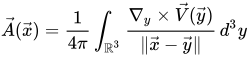
Sei V → : R 3 → R 3 {\displaystyle {\vec {V}}\colon \mathbb {R} ^{3}\to \mathbb {R} ^{3}} {\displaystyle {\vec {V}}\colon \mathbb {R} ^{3}\to \mathbb {R} ^{3}} ein zweifach stetig differenzierbares, quellfreies Vektorfeld, das für ‖ x → ‖ → ∞ {\displaystyle \lVert {\vec {x}}\rVert \to \infty } {\displaystyle \lVert {\vec {x}}\rVert \to \infty } mindestens so schnell abfällt wie 1 ‖ x → ‖ {\displaystyle {\frac {1}{\lVert {\vec {x}}\rVert }}} {\displaystyle {\frac {1}{\lVert {\vec {x}}\rVert }}}. Dann ist durch

A → ( x → ) = 1 4 π ∫ R 3 ∇ y × V → ( y → ) ‖ x → − y → ‖ d 3 y {\displaystyle {\vec {A}}({\vec {x}})={\frac {1}{4\pi }}\int _{\mathbb {R} ^{3}}{\frac {\nabla _{y}\times {\vec {V}}({\vec {y}})}{\left\|{\vec {x}}-{\vec {y}}\right\|}}\,d^{3}y} {\displaystyle {\vec {A}}({\vec {x}})={\frac {1}{4\pi }}\int _{\mathbb {R} ^{3}}{\frac {\nabla _{y}\times {\vec {V}}({\vec {y}})}{\left\|{\vec {x}}-{\vec {y}}\right\|}}\,d^{3}y},

ein Vektorpotential A → {\displaystyle {\vec {A}}} {\displaystyle {\vec {A}}} von V → {\displaystyle {\vec {V}}} {\displaystyle {\vec {V}}} definiert[1].

Dies ist ein Spezialfall des Helmholtz-Theorems.

Uneindeutigkeit

[Bearbeiten | Quelltext bearbeiten]

Das Vektorpotential eines quellfreien Vektorfeldes ist nicht eindeutig definiert. Ist A → {\displaystyle {\vec {A}}} {\displaystyle {\vec {A}}} ein Vektorpotential von V → {\displaystyle {\vec {V}}} {\displaystyle {\vec {V}}}, so ist auch

A → + ∇ → f {\displaystyle {\vec {A}}+{\vec {\nabla }}f} {\displaystyle {\vec {A}}+{\vec {\nabla }}f}

ein Vektorpotential von V → {\displaystyle {\vec {V}}} {\displaystyle {\vec {V}}} für beliebige, stetig differenzierbare Skalarfelder f {\displaystyle f} {\displaystyle f}. Dies folgt aus der Rotationsfreiheit von Gradientenfeldern. In der Physik wird diese Eigenschaft des Vektorpotentials unter dem Thema Eichtransformation behandelt.[1]

Eigenschaften des erzeugten Feldes

[Bearbeiten | Quelltext bearbeiten]

Wenn ein Vektorfeld durch ein Vektorpotential erzeugt werden kann, muss es ein quellfreies Vektorfeld sein.

Dies liegt daran, dass die Divergenz einer Rotation immer Null ist.

d i v V → = d i v r o t A → = 0 {\displaystyle \mathrm {div} \,{\vec {V}}=\mathrm {div} \,\mathrm {rot} \,{\vec {A}}=0} {\displaystyle \mathrm {div} \,{\vec {V}}=\mathrm {div} \,\mathrm {rot} \,{\vec {A}}=0}

Anwendung

[Bearbeiten | Quelltext bearbeiten]

Das Vektorpotential wird vor allem in der Physik angewendet. Beispiele dafür sind

  • das Magnetische Vektorpotential und
  • das Elektrische Vektorpotential

Einzelnachweise

[Bearbeiten | Quelltext bearbeiten]
  1. ↑ a b c Wolfgang Nolting: Grundkurs Theoretische Physik 3 (= Springer-Lehrbuch). Springer Berlin Heidelberg, Berlin, Heidelberg 2013, ISBN 978-3-642-37904-8, S. 188–190, doi:10.1007/978-3-642-37905-5. 
  2. ↑ A. C. T. Wu, Chen Ning Yang: EVOLUTION OF THE CONCEPT OF THE VECTOR POTENTIAL IN THE DESCRIPTION OF FUNDAMENTAL INTERACTIONS. In: International Journal of Modern Physics A. Band 21, Nr. 16, 30. Juni 2006, ISSN 0217-751X, S. 3235–3277, doi:10.1142/S0217751X06033143. 
Abgerufen von „https://de.teknopedia.teknokrat.ac.id/w/index.php?title=Vektorpotential&oldid=235861709“
Kategorie:
  • Vektoranalysis

  • indonesia
  • Polski
  • العربية
  • Deutsch
  • English
  • Español
  • Français
  • Italiano
  • مصرى
  • Nederlands
  • 日本語
  • Português
  • Sinugboanong Binisaya
  • Svenska
  • Українська
  • Tiếng Việt
  • Winaray
  • 中文
  • Русский
Sunting pranala
Pusat Layanan

UNIVERSITAS TEKNOKRAT INDONESIA | ASEAN's Best Private University
Jl. ZA. Pagar Alam No.9 -11, Labuhan Ratu, Kec. Kedaton, Kota Bandar Lampung, Lampung 35132
Phone: (0721) 702022
Email: pmb@teknokrat.ac.id