Technopedia Center
PMB University Brochure
Faculty of Engineering and Computer Science
S1 Informatics S1 Information Systems S1 Information Technology S1 Computer Engineering S1 Electrical Engineering S1 Civil Engineering

faculty of Economics and Business
S1 Management S1 Accountancy

Faculty of Letters and Educational Sciences
S1 English literature S1 English language education S1 Mathematics education S1 Sports Education
  • Registerasi
  • Brosur UTI
  • Kip Scholarship Information
  • Performance
  1. Weltenzyklopädie
  2. Spaltensummennorm – Wikipedia
Spaltensummennorm – Wikipedia 👆 Click Here!
aus Wikipedia, der freien Enzyklopädie
Illustration der Spaltensummennorm

Die Spaltensummennorm ist in der Mathematik die von der Summennorm abgeleitete natürliche Matrixnorm. Die Spaltensummennorm einer Matrix entspricht der maximalen Betragssumme aller ihrer Spalten. Sie ist submultiplikativ und mit der Summennorm verträglich. Die Spaltensummennorm wird insbesondere in der linearen Algebra und der numerischen Mathematik verwendet.

Definition

[Bearbeiten | Quelltext bearbeiten]

Die Spaltensummennorm ‖ ⋅ ‖ 1 {\displaystyle \|\cdot \|_{1}} {\displaystyle \|\cdot \|_{1}} einer Matrix A ∈ K m × n {\displaystyle A\in {\mathbb {K} }^{m\times n}} {\displaystyle A\in {\mathbb {K} }^{m\times n}} mit K {\displaystyle \mathbb {K} } {\displaystyle \mathbb {K} } als dem Körper der reellen oder komplexen Zahlen ist die von der Summennorm abgeleitete natürliche Matrixnorm und damit definiert als

‖ A ‖ 1 := max x ≠ 0 ‖ A x ‖ 1 ‖ x ‖ 1 = max ‖ x ‖ 1 = 1 ‖ A x ‖ 1 {\displaystyle \|A\|_{1}:=\max _{x\neq 0}{\frac {\|Ax\|_{1}}{\|x\|_{1}}}=\max _{\|x\|_{1}=1}\|Ax\|_{1}} {\displaystyle \|A\|_{1}:=\max _{x\neq 0}{\frac {\|Ax\|_{1}}{\|x\|_{1}}}=\max _{\|x\|_{1}=1}\|Ax\|_{1}}.

Anschaulich entspricht die Spaltensummennorm dem größtmöglichen Streckungsfaktor, der durch die Anwendung der Matrix auf einen Vektor mit Betragssumme Eins entsteht. Für die Spaltensummennorm gilt die namensgebende Darstellung

‖ A ‖ 1 = max ‖ x ‖ 1 = 1 ‖ A x ‖ 1 = max ‖ x ‖ 1 = 1 ∑ i = 1 m | ∑ j = 1 n a i j x j | = max j = 1 , … , n ∑ i = 1 m | a i j | {\displaystyle \|A\|_{1}=\max _{\|x\|_{1}=1}\|Ax\|_{1}=\max _{\|x\|_{1}=1}\sum _{i=1}^{m}\left|\sum _{j=1}^{n}a_{ij}x_{j}\right|=\max _{j=1,\ldots ,n}\sum _{i=1}^{m}|a_{ij}|} {\displaystyle \|A\|_{1}=\max _{\|x\|_{1}=1}\|Ax\|_{1}=\max _{\|x\|_{1}=1}\sum _{i=1}^{m}\left|\sum _{j=1}^{n}a_{ij}x_{j}\right|=\max _{j=1,\ldots ,n}\sum _{i=1}^{m}|a_{ij}|}.

Hierbei wurde genutzt, dass die Summe innerhalb der Betragsstriche für festes i {\displaystyle i} {\displaystyle i} für einen der Einheitsvektoren x = ± e j {\displaystyle x=\pm e_{j}} {\displaystyle x=\pm e_{j}} mit j = 1 , … , n {\displaystyle j=1,\ldots ,n} {\displaystyle j=1,\ldots ,n} maximal wird. Die Berechnung der Spaltensummennorm erfolgt also durch die Ermittlung der Betragssumme jeder Spalte und dann durch Auswahl des Maximums dieser Werte. Zur Unterscheidung von der verwandten Zeilensummennorm ‖ ⋅ ‖ ∞ {\displaystyle \|\cdot \|_{\infty }} {\displaystyle \|\cdot \|_{\infty }} hilft folgende Merkregel: die 1 {\displaystyle 1} {\displaystyle 1} steht senkrecht und steht für die Spalten, während die ∞ {\displaystyle \infty } {\displaystyle \infty } waagrecht liegt und für die Zeilen steht.

Beispiele

[Bearbeiten | Quelltext bearbeiten]

Reelle Matrix

Die Spaltensummennorm der reellen (2 × 3)-Matrix
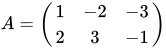
A = ( 1 − 2 − 3 2 3 − 1 ) {\displaystyle A={\begin{pmatrix}1&{-2}&{-3}\\2&3&{-1}\end{pmatrix}}} {\displaystyle A={\begin{pmatrix}1&{-2}&{-3}\\2&3&{-1}\end{pmatrix}}}

berechnet sich als

‖ A ‖ 1 = max { | 1 | + | 2 | , | − 2 | + | 3 | , | − 3 | + | − 1 | } = max { 3 , 5 , 4 } = 5 {\displaystyle \|A\|_{1}=\max\{|1|+|2|,|{-2}|+|3|,|{-3}|+|{-1}|\}=\max\{3,5,4\}=5} {\displaystyle \|A\|_{1}=\max\{|1|+|2|,|{-2}|+|3|,|{-3}|+|{-1}|\}=\max\{3,5,4\}=5}.

Komplexe Matrix

Die Spaltensummennorm der komplexen (2 × 3)-Matrix
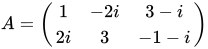
A = ( 1 − 2 i 3 − i 2 i 3 − 1 − i ) {\displaystyle A={\begin{pmatrix}1&-2i&3-i\\2i&3&-1-i\end{pmatrix}}} {\displaystyle A={\begin{pmatrix}1&-2i&3-i\\2i&3&-1-i\end{pmatrix}}}

berechnet sich als

‖ A ‖ 1 = max { | 1 | + | 2 i | , | − 2 i | + | 3 | , | 3 − i | + | − 1 − i | } = max { 3 , 5 , 10 + 2 } = 5 {\displaystyle \|A\|_{1}=\max\{|1|+|2i|,|-2i|+|3|,|3-i|+|-1-i|\}=\max\{3,5,{\sqrt {10}}+{\sqrt {2}}\}=5} {\displaystyle \|A\|_{1}=\max\{|1|+|2i|,|-2i|+|3|,|3-i|+|-1-i|\}=\max\{3,5,{\sqrt {10}}+{\sqrt {2}}\}=5}.

Eigenschaften

[Bearbeiten | Quelltext bearbeiten]

Normeigenschaften

[Bearbeiten | Quelltext bearbeiten]

Die Normaxiome Definitheit, absolute Homogenität und Subadditivität folgen für die Spaltensummennorm direkt aus den entsprechenden Eigenschaften von natürlichen Matrixnormen. Insbesondere ist die Spaltensummennorm damit auch submultiplikativ und mit der Summennorm verträglich, das heißt, es gilt

‖ A ⋅ x ‖ 1 ≤ ‖ A ‖ 1 ⋅ ‖ x ‖ 1 {\displaystyle \|A\cdot x\|_{1}\leq \|A\|_{1}\cdot \|x\|_{1}} {\displaystyle \|A\cdot x\|_{1}\leq \|A\|_{1}\cdot \|x\|_{1}}

für alle Matrizen A ∈ K m × n {\displaystyle A\in {\mathbb {K} }^{m\times n}} {\displaystyle A\in {\mathbb {K} }^{m\times n}} und alle Vektoren x ∈ K n {\displaystyle x\in {\mathbb {K} }^{n}} {\displaystyle x\in {\mathbb {K} }^{n}} und die Spaltensummennorm ist die kleinste Norm mit dieser Eigenschaft.

Adjungierte

[Bearbeiten | Quelltext bearbeiten]

Für eine adjungierte Matrix A H ∈ K n × m {\displaystyle A^{H}\in {\mathbb {K} }^{n\times m}} {\displaystyle A^{H}\in {\mathbb {K} }^{n\times m}} (im reellen Fall transponierte Matrix) gilt

‖ A H ‖ 1 = max j = 1 , … , n ∑ i = 1 m | a ¯ j i | = max i = 1 , … , n ∑ j = 1 m | a i j | = ‖ A ‖ ∞ {\displaystyle \|A^{H}\|_{1}=\max _{j=1,\ldots ,n}\sum _{i=1}^{m}|{\bar {a}}_{ji}|=\max _{i=1,\ldots ,n}\sum _{j=1}^{m}|a_{ij}|=\|A\|_{\infty }} {\displaystyle \|A^{H}\|_{1}=\max _{j=1,\ldots ,n}\sum _{i=1}^{m}|{\bar {a}}_{ji}|=\max _{i=1,\ldots ,n}\sum _{j=1}^{m}|a_{ij}|=\|A\|_{\infty }},

wobei a ¯ {\displaystyle {\bar {a}}} {\displaystyle {\bar {a}}} die konjugiert komplexe Zahl zu a {\displaystyle a} {\displaystyle a} mit dem gleichen Betrag ist. Die Spaltensummennorm einer adjungierten oder transponierten Matrix entspricht also der Zeilensummennorm der Ausgangsmatrix. Die Spektralnorm einer Matrix kann dadurch als geometrisches Mittel aus Zeilen- und Spaltensummennorm nach oben abgeschätzt werden.

Literatur

[Bearbeiten | Quelltext bearbeiten]
  • Hans Rudolf Schwarz, Norbert Köckler: Numerische Mathematik. 8. Auflage. Vieweg & Teubner, 2011, ISBN 978-3-8348-1551-4. 

Weblinks

[Bearbeiten | Quelltext bearbeiten]
  • Eric W. Weisstein: Maximum Absolute Column Sum Norm. In: MathWorld (englisch).
Abgerufen von „https://de.teknopedia.teknokrat.ac.id/w/index.php?title=Spaltensummennorm&oldid=190253052“
Kategorien:
  • Numerische lineare Algebra
  • Norm (Mathematik)

  • indonesia
  • Polski
  • العربية
  • Deutsch
  • English
  • Español
  • Français
  • Italiano
  • مصرى
  • Nederlands
  • 日本語
  • Português
  • Sinugboanong Binisaya
  • Svenska
  • Українська
  • Tiếng Việt
  • Winaray
  • 中文
  • Русский
Sunting pranala
Pusat Layanan

UNIVERSITAS TEKNOKRAT INDONESIA | ASEAN's Best Private University
Jl. ZA. Pagar Alam No.9 -11, Labuhan Ratu, Kec. Kedaton, Kota Bandar Lampung, Lampung 35132
Phone: (0721) 702022
Email: pmb@teknokrat.ac.id




