Technopedia Center
PMB University Brochure
Faculty of Engineering and Computer Science
S1 Informatics S1 Information Systems S1 Information Technology S1 Computer Engineering S1 Electrical Engineering S1 Civil Engineering

faculty of Economics and Business
S1 Management S1 Accountancy

Faculty of Letters and Educational Sciences
S1 English literature S1 English language education S1 Mathematics education S1 Sports Education
  • Registerasi
  • Brosur UTI
  • Kip Scholarship Information
  • Performance
  1. Weltenzyklopädie
  2. Normaler Operator – Wikipedia
Normaler Operator – Wikipedia 👆 Click Here!
aus Wikipedia, der freien Enzyklopädie

In der Funktionalanalysis verallgemeinert der normale Operator den Begriff der normalen Matrix aus der linearen Algebra.

Definition

[Bearbeiten | Quelltext bearbeiten]

Ist X {\displaystyle X} {\displaystyle X} ein Hilbertraum und bezeichnet L ( X ) {\displaystyle {\mathcal {L}}(X)} {\displaystyle {\mathcal {L}}(X)} die Menge aller stetigen Endomorphismen von X {\displaystyle X} {\displaystyle X}, so heißt ein Operator A ∈ L ( X ) {\displaystyle A\in {\mathcal {L}}(X)} {\displaystyle A\in {\mathcal {L}}(X)} normal, falls er mit seinem adjungierten Operator A ∗ {\displaystyle A^{\ast }} {\displaystyle A^{\ast }} kommutiert, also wenn

A A ∗ = A ∗ A {\displaystyle AA^{\ast }=A^{\ast }A} {\displaystyle AA^{\ast }=A^{\ast }A}

gilt.

Beispiele

[Bearbeiten | Quelltext bearbeiten]
  • Selbstadjungierte und unitäre Operatoren sind offenbar normal.
  • Der unilaterale Shift ist ein Beispiel für einen nicht-normalen Operator.

Eigenschaften

[Bearbeiten | Quelltext bearbeiten]

Sei A ∈ L ( X ) {\displaystyle A\in {\mathcal {L}}(X)} {\displaystyle A\in {\mathcal {L}}(X)} ein normaler Operator. Dann gilt:

  • ‖ A x ‖ = ‖ A ∗ x ‖ {\displaystyle \|Ax\|=\|A^{\ast }x\|} {\displaystyle \|Ax\|=\|A^{\ast }x\|} für alle x ∈ X {\displaystyle x\in X} {\displaystyle x\in X}
  • ‖ A x ‖ 2 ≤ ‖ A 2 x ‖ ‖ x ‖ {\displaystyle \|Ax\|^{2}\leq \|A^{2}x\|\|x\|} {\displaystyle \|Ax\|^{2}\leq \|A^{2}x\|\|x\|} für alle x ∈ X {\displaystyle x\in X} {\displaystyle x\in X}
  • Die Operatornorm von A {\displaystyle A} {\displaystyle A} ist gleich dem Spektralradius: ‖ A ‖ = sup { | λ | : λ ∈ σ ( A ) } . {\displaystyle \|A\|=\sup\{|\lambda |\colon \lambda \in \sigma (A)\}.} {\displaystyle \|A\|=\sup\{|\lambda |\colon \lambda \in \sigma (A)\}.} Dabei bezeichnet σ ( A ) {\displaystyle \sigma (A)} {\displaystyle \sigma (A)} das Spektrum von A {\displaystyle A} {\displaystyle A}.
  • Die von A {\displaystyle A} {\displaystyle A} erzeugte C*-Algebra und die von A {\displaystyle A} {\displaystyle A} erzeugte Von-Neumann-Algebra sind kommutativ. Dieser Sachverhalt ermöglicht einen Funktionalkalkül.
  • Die Diagonalisierbarkeit normaler Matrizen in der linearen Algebra verallgemeinert sich auf normale Operatoren in Form des Spektralsatzes.
  • Eine Klassifikation normaler Operatoren besteht bzgl. unitärer Äquivalenz modulo kompakter Operatoren, indem man zur Calkin-Algebra übergeht, die im endlich-dimensionalen Fall { 0 } {\displaystyle \{0\}} {\displaystyle \{0\}} ist. Das ist im Artikel zur Calkin-Algebra ausgeführt.
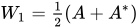
  • Ein beschränkter Operator A {\displaystyle A} {\displaystyle A} in einem komplexen Hilbertraum lässt sich zerlegen in A = W 1 + i W 2 {\displaystyle A=W_{1}+i\,W_{2}} {\displaystyle A=W_{1}+i\,W_{2}} mit dem „Realteil“ W 1 = 1 2 ( A + A ∗ ) {\displaystyle W_{1}={\tfrac {1}{2}}(A+A^{\ast })} {\displaystyle W_{1}={\tfrac {1}{2}}(A+A^{\ast })} und dem „Imaginärteil“ W 2 = 1 2 i ( A − A ∗ ) . {\displaystyle W_{2}={\tfrac {1}{2i}}(A-A^{\ast }).} {\displaystyle W_{2}={\tfrac {1}{2i}}(A-A^{\ast }).} Dabei sind die Operatoren W i {\displaystyle W_{i}} {\displaystyle W_{i}} selbstadjungiert. A {\displaystyle A} {\displaystyle A} ist genau dann normal, wenn W 1 W 2 = W 2 W 1 {\displaystyle W_{1}W_{2}=W_{2}W_{1}} {\displaystyle W_{1}W_{2}=W_{2}W_{1}}.

Verwandte Begriffe

[Bearbeiten | Quelltext bearbeiten]

Ein Operator A ∈ L ( X ) {\displaystyle A\in {\mathcal {L}}(X)} {\displaystyle A\in {\mathcal {L}}(X)} heißt

  • quasinormal, falls A {\displaystyle A\,\!} {\displaystyle A\,\!} mit A ∗ A {\displaystyle A^{\ast }A} {\displaystyle A^{\ast }A} vertauscht, das heißt A A ∗ A = A ∗ A A {\displaystyle AA^{\ast }A=A^{\ast }AA} {\displaystyle AA^{\ast }A=A^{\ast }AA}.
  • subnormal, falls es einen Hilbertraum Y {\displaystyle Y} {\displaystyle Y} gibt, so dass X {\displaystyle X} {\displaystyle X} Unterraum von Y {\displaystyle Y} {\displaystyle Y} ist, und einen normalen Operator B ∈ L ( Y ) {\displaystyle B\in {\mathcal {L}}(Y)} {\displaystyle B\in {\mathcal {L}}(Y)}, so dass B ( X ) ⊂ X {\displaystyle B(X)\subset X} {\displaystyle B(X)\subset X} und A = B | X {\displaystyle A=B|_{X}} {\displaystyle A=B|_{X}}.
  • hyponormal, falls ‖ A ∗ x ‖ ≤ ‖ A x ‖ {\displaystyle \|A^{\ast }x\|\leq \|Ax\|} {\displaystyle \|A^{\ast }x\|\leq \|Ax\|} für alle x ∈ X {\displaystyle x\in X} {\displaystyle x\in X}.
  • paranormal, falls ‖ A x ‖ 2 ≤ ‖ A 2 x ‖ ‖ x ‖ {\displaystyle \|Ax\|^{2}\leq \|A^{2}x\|\|x\|} {\displaystyle \|Ax\|^{2}\leq \|A^{2}x\|\|x\|} für alle x ∈ X {\displaystyle x\in X} {\displaystyle x\in X}.
  • normaloid, falls Operatornorm = Spektralradius, d. h.: ‖ A ‖ = sup { | λ | ; λ ∈ σ ( A ) } {\displaystyle \|A\|=\sup\{|\lambda |;\lambda \in \sigma (A)\}} {\displaystyle \|A\|=\sup\{|\lambda |;\lambda \in \sigma (A)\}}.

Es gelten folgende Implikationen:

normal ⇒ {\displaystyle \Rightarrow } {\displaystyle \Rightarrow } quasinormal ⇒ {\displaystyle \Rightarrow } {\displaystyle \Rightarrow } subnormal ⇒ {\displaystyle \Rightarrow } {\displaystyle \Rightarrow } hyponormal ⇒ {\displaystyle \Rightarrow } {\displaystyle \Rightarrow } paranormal ⇒ {\displaystyle \Rightarrow } {\displaystyle \Rightarrow } normaloid.

Unbeschränkte Operatoren

[Bearbeiten | Quelltext bearbeiten]

Ein unbeschränkter Operator A : D ( A ) ⊆ X → X {\displaystyle A:D(A)\subseteq X\to X} {\displaystyle A:D(A)\subseteq X\to X} mit Definitionsbereich D ( A ) {\displaystyle D(A)} {\displaystyle D(A)} heißt normal falls

‖ A x ‖ = ‖ A ∗ x ‖ , ∀ x ∈ D ( A ) = D ( A ∗ ) {\displaystyle \|Ax\|=\|A^{\ast }x\|,\qquad \forall x\in D(A)=D(A^{\ast })} {\displaystyle \|Ax\|=\|A^{\ast }x\|,\qquad \forall x\in D(A)=D(A^{\ast })}

gilt. Oben genannte äquivalente Charakterisierung der Normalität zeigt, dass es sich um eine Verallgemeinerung der Normalität beschränkter Operatoren handelt. Alle selbstadjungierten Operatoren sind normal, denn für diese gilt A ∗ = A {\displaystyle A^{\ast }=A} {\displaystyle A^{\ast }=A}.

Literatur

[Bearbeiten | Quelltext bearbeiten]
  • Harro Heuser: Funktionalanalysis. B.G. Teubner, Stuttgart (1986), ISBN 3-519-22206-X.
  • Gerald Teschl: Mathematical Methods in Quantum Mechanics, American Mathematical Society, Providence (2009), ISBN 978-0-8218-4660-5. (freie Online-Version)
Abgerufen von „https://de.teknopedia.teknokrat.ac.id/w/index.php?title=Normaler_Operator&oldid=218452651“
Kategorie:
  • Funktionalanalysis

  • indonesia
  • Polski
  • العربية
  • Deutsch
  • English
  • Español
  • Français
  • Italiano
  • مصرى
  • Nederlands
  • 日本語
  • Português
  • Sinugboanong Binisaya
  • Svenska
  • Українська
  • Tiếng Việt
  • Winaray
  • 中文
  • Русский
Sunting pranala
Pusat Layanan

UNIVERSITAS TEKNOKRAT INDONESIA | ASEAN's Best Private University
Jl. ZA. Pagar Alam No.9 -11, Labuhan Ratu, Kec. Kedaton, Kota Bandar Lampung, Lampung 35132
Phone: (0721) 702022
Email: pmb@teknokrat.ac.id