Technopedia Center
PMB University Brochure
Faculty of Engineering and Computer Science
S1 Informatics S1 Information Systems S1 Information Technology S1 Computer Engineering S1 Electrical Engineering S1 Civil Engineering

faculty of Economics and Business
S1 Management S1 Accountancy

Faculty of Letters and Educational Sciences
S1 English literature S1 English language education S1 Mathematics education S1 Sports Education
  • Registerasi
  • Brosur UTI
  • Kip Scholarship Information
  • Performance
  1. Weltenzyklopädie
  2. NOR-Gatter – Wikipedia
NOR-Gatter – Wikipedia 👆 Click Here!
aus Wikipedia, der freien Enzyklopädie
Gatter-Typen
NOT
AND NAND
OR NOR
XOR XNOR
AOI OAI

Ein NOR-Gatter (von englisch: not or – nicht oder, oder von englisch nor – (weder … noch …)), auch Peirce-Funktion nach Charles S. Peirce genannt, ist ein Logikgatter mit zwei oder mehr Eingängen A, B, … und einem Ausgang Y, zwischen denen die logische Verknüpfung NICHT ODER besteht. Ein NOR-Gatter gibt am Ausgang 1 (w) aus, wenn alle Eingänge 0 (f) sind. In allen anderen Fällen, d. h. wenn mindestens ein Eingang 1 ist, wird eine 0 ausgegeben.

Für die NOR-Verknüpfung der Variablen A und B gibt es in der Literatur folgende Schreibweisen:

A NOR B A ↓ B ¬ ( A ∨ B ) A ∨ ¯ B A ∨ B ¯ A + B ¯ A + ¯ B ¬ ( A + B ) {\displaystyle A\,\operatorname {NOR} \,B\qquad A\downarrow B\qquad \neg \left(A\lor B\right)\qquad A\;\;\!\!{\overline {\lor }}\;\;\!\!B\qquad {\overline {A\lor B}}\qquad {\overline {A+B}}\qquad A\;\;\!\!{\overline {+}}\;\;\!\!B\qquad \neg \left(A+B\right)} {\displaystyle A\,\operatorname {NOR} \,B\qquad A\downarrow B\qquad \neg \left(A\lor B\right)\qquad A\;\;\!\!{\overline {\lor }}\;\;\!\!B\qquad {\overline {A\lor B}}\qquad {\overline {A+B}}\qquad A\;\;\!\!{\overline {+}}\;\;\!\!B\qquad \neg \left(A+B\right)}

Übersicht

[Bearbeiten | Quelltext bearbeiten]
Funktion Schaltsymbol Wahrheitstabelle Relais-Logik
IEC 60617-12 US ANSI 91-1984 DIN 40700 (vor 1976)
Y = A ∨ B ¯ {\displaystyle Y={\overline {A\vee B}}} {\displaystyle Y={\overline {A\vee B}}}

Y = A ∨ ¯ B {\displaystyle Y=A\;\;\!\!{\overline {\vee }}\;\;\!\!B} {\displaystyle Y=A\;\;\!\!{\overline {\vee }}\;\;\!\!B}

Y = A + B ¯ {\displaystyle Y={\overline {A+B}}} {\displaystyle Y={\overline {A+B}}}

Y = A ↓ B {\displaystyle Y=A\downarrow B} {\displaystyle Y=A\downarrow B}

Y = A ∖ B {\displaystyle Y=A\backslash B} {\displaystyle Y=A\backslash B}
A B Y = A ⊽ B
0 0 1
0 1 0
1 0 0
1 1 0

Logiksynthese

[Bearbeiten | Quelltext bearbeiten]

Gemäß folgender logischer Äquivalenz kann eine NOR-Verknüpfung aber auch allein aus NAND-Gattern aufgebaut werden:

x   ∨ ¯   y = ( ( x   ∧ ¯   x )   ∧ ¯   ( y   ∧ ¯   y ) )   ∧ ¯   ( ( x   ∧ ¯   x )   ∧ ¯   ( y   ∧ ¯   y ) ) {\displaystyle x\ {\overline {\lor }}\ y=\left(\left(x\ {\overline {\land }}\ x\right)\ {\overline {\land }}\ \left(y\ {\overline {\land }}\ y\right)\right)\ {\overline {\land }}\ \left(\left(x\ {\overline {\land }}\ x\right)\ {\overline {\land }}\ \left(y\ {\overline {\land }}\ y\right)\right)} {\displaystyle x\ {\overline {\lor }}\ y=\left(\left(x\ {\overline {\land }}\ x\right)\ {\overline {\land }}\ \left(y\ {\overline {\land }}\ y\right)\right)\ {\overline {\land }}\ \left(\left(x\ {\overline {\land }}\ x\right)\ {\overline {\land }}\ \left(y\ {\overline {\land }}\ y\right)\right)}

Logische Verknüpfungen und deren Umsetzung mittels NOR-Gattern:

Mit der Peirce-Funktion allein sind alle zweiwertigen Wahrheitsfunktionen darstellbar, das heißt, jede boolesche Funktion ist äquivalent zu einer Formel, die ausschließlich die NOR-Funktion enthält. Auf Grund dieser Eigenschaft der funktionalen Vollständigkeit nennt man die Peirce-Funktion eine Basis der zweistelligen logischen Funktionen (eine weitere Basis ist die NAND-Funktion).

Verknüpfung Umsetzung Umsetzung in Formelschreibweise Schaltsymbole
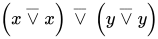
Negation NOT x x NOR x x   ∨ ¯   x {\displaystyle x\ {\overline {\lor }}\ x} {\displaystyle x\ {\overline {\lor }}\ x}
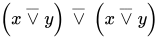
Konjunktion x AND y (x NOR x) NOR (y NOR y) ( x   ∨ ¯   x )   ∨ ¯   ( y   ∨ ¯   y ) {\displaystyle \left(x\ {\overline {\lor }}\ x\right)\ {\overline {\lor }}\ \left(y\ {\overline {\lor }}\ y\right)} {\displaystyle \left(x\ {\overline {\lor }}\ x\right)\ {\overline {\lor }}\ \left(y\ {\overline {\lor }}\ y\right)}
Nicht-Und x NAND y ((x NOR x) NOR (y NOR y)) NOR ((x NOR x) NOR (y NOR y)) ( ( x   ∨ ¯   x )   ∨ ¯   ( y   ∨ ¯   y ) )   ∨ ¯   ( ( x   ∨ ¯   x )   ∨ ¯   ( y   ∨ ¯   y ) ) {\displaystyle \left(\left(x\ {\overline {\lor }}\ x\right)\ {\overline {\lor }}\ \left(y\ {\overline {\lor }}\ y\right)\right)\ {\overline {\lor }}\ \left(\left(x\ {\overline {\lor }}\ x\right)\ {\overline {\lor }}\ \left(y\ {\overline {\lor }}\ y\right)\right)} {\displaystyle \left(\left(x\ {\overline {\lor }}\ x\right)\ {\overline {\lor }}\ \left(y\ {\overline {\lor }}\ y\right)\right)\ {\overline {\lor }}\ \left(\left(x\ {\overline {\lor }}\ x\right)\ {\overline {\lor }}\ \left(y\ {\overline {\lor }}\ y\right)\right)}
Disjunktion x OR y (x NOR y) NOR (x NOR y) ( x   ∨ ¯   y )   ∨ ¯   ( x   ∨ ¯   y ) {\displaystyle \left(x\ {\overline {\lor }}\ y\right)\ {\overline {\lor }}\ \left(x\ {\overline {\lor }}\ y\right)} {\displaystyle \left(x\ {\overline {\lor }}\ y\right)\ {\overline {\lor }}\ \left(x\ {\overline {\lor }}\ y\right)}
Nicht-Oder x NOR y x NOR y x   ∨ ¯   y {\displaystyle x\ {\overline {\lor }}\ y} {\displaystyle x\ {\overline {\lor }}\ y}
Kontravalenz x XOR y (x NOR y) NOR ((x NOR x) NOR (y NOR y)) ( x   ∨ ¯   y )   ∨ ¯   ( ( x   ∨ ¯   x )   ∨ ¯   ( y   ∨ ¯   y ) ) {\displaystyle \left(x\ {\overline {\lor }}\ y\right)\ {\overline {\lor }}\ \left(\left(x\ {\overline {\lor }}\ x\right)\ {\overline {\lor }}\ \left(y\ {\overline {\lor }}\ y\right)\right)} {\displaystyle \left(x\ {\overline {\lor }}\ y\right)\ {\overline {\lor }}\ \left(\left(x\ {\overline {\lor }}\ x\right)\ {\overline {\lor }}\ \left(y\ {\overline {\lor }}\ y\right)\right)}
Äquivalenz x XNOR y ((x NOR y) NOR x) NOR ((x NOR y) NOR y) ( ( x   ∨ ¯   x )   ∨ ¯   y )   ∨ ¯   ( x   ∨ ¯   ( y   ∨ ¯   y ) ) {\displaystyle \left(\left(x\ {\overline {\lor }}\ x\right)\ {\overline {\lor }}\ y\right)\ {\overline {\lor }}\ \left(x\ {\overline {\lor }}\ \left(y\ {\overline {\lor }}\ y\right)\right)} {\displaystyle \left(\left(x\ {\overline {\lor }}\ x\right)\ {\overline {\lor }}\ y\right)\ {\overline {\lor }}\ \left(x\ {\overline {\lor }}\ \left(y\ {\overline {\lor }}\ y\right)\right)}
((x NOR y) NOR x) NOR ((x NOR y) NOR y) ( ( x   ∨ ¯   y )   ∨ ¯   x )   ∨ ¯   ( ( x   ∨ ¯   y )   ∨ ¯   y ) {\displaystyle \left(\left(x\ {\overline {\lor }}\ y\right)\ {\overline {\lor }}\ x\right)\ {\overline {\lor }}\ \left(\left(x\ {\overline {\lor }}\ y\right)\ {\overline {\lor }}\ y\right)} {\displaystyle \left(\left(x\ {\overline {\lor }}\ y\right)\ {\overline {\lor }}\ x\right)\ {\overline {\lor }}\ \left(\left(x\ {\overline {\lor }}\ y\right)\ {\overline {\lor }}\ y\right)}
≡ x ⇔ y
Implikation x ⇒ y ((x NOR x) NOR y) NOR ((x NOR x) NOR y) ( ( x   ∨ ¯   x )   ∨ ¯   y )   ∨ ¯   ( ( x   ∨ ¯   x )   ∨ ¯   y ) {\displaystyle \left(\left(x\ {\overline {\lor }}\ x\right)\ {\overline {\lor }}\ y\right)\ {\overline {\lor }}\ \left(\left(x\ {\overline {\lor }}\ x\right)\ {\overline {\lor }}\ y\right)} {\displaystyle \left(\left(x\ {\overline {\lor }}\ x\right)\ {\overline {\lor }}\ y\right)\ {\overline {\lor }}\ \left(\left(x\ {\overline {\lor }}\ x\right)\ {\overline {\lor }}\ y\right)}
x ⇐ y (x NOR (y NOR y)) NOR (x NOR (y NOR y)) ( x   ∨ ¯   ( y   ∨ ¯   y ) )   ∨ ¯   ( x   ∨ ¯   ( y   ∨ ¯   y ) ) {\displaystyle \left(x\ {\overline {\lor }}\ \left(y\ {\overline {\lor }}\ y\right)\right)\ {\overline {\lor }}\ \left(x\ {\overline {\lor }}\ \left(y\ {\overline {\lor }}\ y\right)\right)} {\displaystyle \left(x\ {\overline {\lor }}\ \left(y\ {\overline {\lor }}\ y\right)\right)\ {\overline {\lor }}\ \left(x\ {\overline {\lor }}\ \left(y\ {\overline {\lor }}\ y\right)\right)}
Tautologie verum ((x NOR x) NOR x) NOR ((x NOR x) NOR x) ( ( x   ∨ ¯   x )   ∨ ¯   x )   ∨ ¯   ( ( x   ∨ ¯   x )   ∨ ¯   x ) {\displaystyle \left(\left(x\ {\overline {\lor }}\ x\right)\ {\overline {\lor }}\ x\right)\ {\overline {\lor }}\ \left(\left(x\ {\overline {\lor }}\ x\right)\ {\overline {\lor }}\ x\right)} {\displaystyle \left(\left(x\ {\overline {\lor }}\ x\right)\ {\overline {\lor }}\ x\right)\ {\overline {\lor }}\ \left(\left(x\ {\overline {\lor }}\ x\right)\ {\overline {\lor }}\ x\right)}
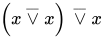
Kontradiktion falsum (x NOR x) NOR x ( x   ∨ ¯   x )   ∨ ¯   x {\displaystyle \left(x\ {\overline {\lor }}\ x\right)\ {\overline {\lor }}\ x} {\displaystyle \left(x\ {\overline {\lor }}\ x\right)\ {\overline {\lor }}\ x}

Realisierung

[Bearbeiten | Quelltext bearbeiten]

Die elektronische Realisierung erfolgt zum Beispiel (bei positiver Logik) mit zwei (oder entsprechend mehr) parallel geschalteten Schaltern (Transistoren), die den Ausgang Q auf Masse (logisch 0) legen, sobald einer von ihnen eingeschaltet ist. Sind alle aus, so ist die Masseverbindung unterbrochen und der Ausgang Q liegt auf Pluspotenzial (logisch 1).

  • Funktionsprinzip eines NOR-Gatters '"`UNIQ--postMath-00000014-QINU`"'
    Funktionsprinzip eines NOR-Gatters
    Q = x NOR y {\displaystyle Q=x\,\operatorname {NOR} \,y} {\displaystyle Q=x\,\operatorname {NOR} \,y}
  • Aufbau eines NOR-Gatters in RTL-Technik (Widerstands-Transistor-Logik)
    Aufbau eines NOR-Gatters in RTL-Technik (Widerstands-Transistor-Logik)
  • Realisierung eines NOR-Gatters in CMOS-Technik '"`UNIQ--postMath-00000015-QINU`"' (ungünstig zu implementieren, da die beiden PMOS-Transistoren seriell geschaltet sind und bei gleicher Chipfläche ohnehin schon hochohmiger als NMOS-Transistoren sind)
    Realisierung eines NOR-Gatters in CMOS-Technik a ∨ ¯ b = a NOR b {\displaystyle a\;\;\!\!{\overline {\lor }}\;\;\!\!b=a\,\operatorname {NOR} \,b} {\displaystyle a\;\;\!\!{\overline {\lor }}\;\;\!\!b=a\,\operatorname {NOR} \,b} (ungünstig zu implementieren, da die beiden PMOS-Transistoren seriell geschaltet sind und bei gleicher Chipfläche ohnehin schon hochohmiger als NMOS-Transistoren sind)

Literatur

[Bearbeiten | Quelltext bearbeiten]
  • Ulrich Tietze, Christoph Schenk: Halbleiter-Schaltungstechnik. 12. Auflage. Springer, 2002, ISBN 3-540-42849-6. 
Abgerufen von „https://de.teknopedia.teknokrat.ac.id/w/index.php?title=NOR-Gatter&oldid=253722034“
Kategorien:
  • Digitale Schaltungstechnik
  • Schaltalgebra

  • indonesia
  • Polski
  • العربية
  • Deutsch
  • English
  • Español
  • Français
  • Italiano
  • مصرى
  • Nederlands
  • 日本語
  • Português
  • Sinugboanong Binisaya
  • Svenska
  • Українська
  • Tiếng Việt
  • Winaray
  • 中文
  • Русский
Sunting pranala
Pusat Layanan

UNIVERSITAS TEKNOKRAT INDONESIA | ASEAN's Best Private University
Jl. ZA. Pagar Alam No.9 -11, Labuhan Ratu, Kec. Kedaton, Kota Bandar Lampung, Lampung 35132
Phone: (0721) 702022
Email: pmb@teknokrat.ac.id