Technopedia Center
PMB University Brochure
Faculty of Engineering and Computer Science
S1 Informatics S1 Information Systems S1 Information Technology S1 Computer Engineering S1 Electrical Engineering S1 Civil Engineering

faculty of Economics and Business
S1 Management S1 Accountancy

Faculty of Letters and Educational Sciences
S1 English literature S1 English language education S1 Mathematics education S1 Sports Education
  • Registerasi
  • Brosur UTI
  • Kip Scholarship Information
  • Performance
  1. Weltenzyklopädie
  2. Diskreter Logarithmus – Wikipedia
Diskreter Logarithmus – Wikipedia 👆 Click Here!
aus Wikipedia, der freien Enzyklopädie
(Weitergeleitet von Diskreter-Logarithmus-Problem)

In der Gruppentheorie und Zahlentheorie ist der diskrete Logarithmus das Analogon zum gewöhnlichen Logarithmus aus der Analysis; diskret kann in diesem Zusammenhang etwa wie ganzzahlig verstanden werden. Die diskrete Exponentiation in einer zyklischen Gruppe ist die Umkehrfunktion des diskreten Logarithmus. Als Vergleich: Die natürliche Exponentialfunktion auf den reellen Zahlen ist die Umkehrfunktion des natürlichen Logarithmus.

Ein wichtiger Anwendungsfall tritt beim Rechnen modulo p auf. Der diskrete Logarithmus von m {\displaystyle m} {\displaystyle m} zur Basis a {\displaystyle a} {\displaystyle a} ist hier der kleinste Exponent x {\displaystyle x} {\displaystyle x} der Gleichung a x ≡ m mod p {\textstyle a^{x}\equiv m\mod p} {\textstyle a^{x}\equiv m\mod p} bei gegebenen natürlichen Zahlen m {\displaystyle m} {\displaystyle m}, a {\displaystyle a} {\displaystyle a} und der Primzahl p {\displaystyle p} {\displaystyle p}. Zum Beispiel ist beim Rechnen modulo 11 {\textstyle 11} {\textstyle 11} der diskrete Logarithmus von 5 {\displaystyle 5} {\displaystyle 5} zur Basis 2 {\displaystyle 2} {\displaystyle 2} gleich 4 {\textstyle 4} {\textstyle 4}, da 2 4 = 16 ≡ 5 mod 11 {\textstyle 2^{4}=16\equiv 5\mod 11} {\textstyle 2^{4}=16\equiv 5\mod 11} ist.

Da für den diskreten Logarithmus meist nur ineffiziente (im Sinne der Komplexitätstheorie) Algorithmen bekannt sind, während sich die Umkehrfunktion, die diskrete Exponentialfunktion, leicht (im Sinne der Komplexitätstheorie) berechnen lässt, eignet sich die diskrete Exponentialfunktion als Einwegfunktion in der Kryptografie. Anwendungsbeispiele sind u. a.

  • Diffie-Hellman-Schlüsselaustausch
  • Elgamal-Signaturverfahren
  • Schnorr-Signaturverfahren
  • DSA-Verfahren
  • Elliptische-Kurven-Kryptosystem

Theorie

[Bearbeiten | Quelltext bearbeiten]

Allgemeine Definition

[Bearbeiten | Quelltext bearbeiten]

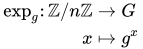
Es sei ( G , ∘ ) {\textstyle (G,\circ )} {\textstyle (G,\circ )} eine endliche zyklische Gruppe mit Erzeuger g {\textstyle g} {\textstyle g} der Ordnung n {\textstyle n} {\textstyle n}. Mit der Restklassengruppe Z / n Z {\textstyle \mathbb {Z} /n\mathbb {Z} } {\textstyle \mathbb {Z} /n\mathbb {Z} } ist die diskrete Exponentiation

exp g : Z / n Z → G x ↦ g x {\textstyle {\begin{aligned}\exp _{g}\colon \mathbb {Z} /n\mathbb {Z} &\to G\\x&\mapsto g^{x}\end{aligned}}} {\textstyle {\begin{aligned}\exp _{g}\colon \mathbb {Z} /n\mathbb {Z} &\to G\\x&\mapsto g^{x}\end{aligned}}}

ein Gruppenisomorphismus. Die zugehörige Umkehrfunktion
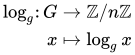
log g : G → Z / n Z x ↦ log g ⁡ x {\textstyle {\begin{aligned}\log _{g}\colon G&\to \mathbb {Z} /n\mathbb {Z} \\x&\mapsto \log _{g}x\end{aligned}}} {\textstyle {\begin{aligned}\log _{g}\colon G&\to \mathbb {Z} /n\mathbb {Z} \\x&\mapsto \log _{g}x\end{aligned}}}

heißt diskreter Logarithmus zur Basis g {\textstyle g} {\textstyle g}.

Die bekannte Basiswechselformel bleibt gültig: Ist h {\displaystyle h} {\displaystyle h} ein weiterer Erzeuger, dann ist

log h ⁡ x = log h ⁡ g ⋅ log g ⁡ x mod n {\textstyle \log _{h}x=\log _{h}g\cdot \log _{g}x\mod n} {\textstyle \log _{h}x=\log _{h}g\cdot \log _{g}x\mod n}.

Weiterhin gilt die folgende Beziehung für den diskreten Logarithmus, die der Funktionalgleichung des Logarithmus entspricht:

log g ⁡ x + log g ⁡ y = log g ⁡ ( x ∘ y ) mod n {\textstyle \log _{g}x+\log _{g}y=\log _{g}(x\circ y)\mod n} {\textstyle \log _{g}x+\log _{g}y=\log _{g}(x\circ y)\mod n}.

Prime Restklassengruppe

[Bearbeiten | Quelltext bearbeiten]

Von praktischem Nutzen in der Kryptografie ist der Spezialfall, wenn die zyklische Gruppe eine prime Restklassengruppe ist, insbesondere modulo Primzahlen.

Sei p {\textstyle p} {\textstyle p} eine Primzahl und g {\displaystyle g} {\displaystyle g} eine Primitivwurzel modulo p {\textstyle p} {\textstyle p}, also ein Erzeuger der primen Restklassengruppe ( Z / p Z ) × {\textstyle (\mathbb {Z} /p\mathbb {Z} )^{\times }} {\textstyle (\mathbb {Z} /p\mathbb {Z} )^{\times }}. Der diskrete Logarithmus (auch Index genannt) einer zu p {\textstyle p} {\textstyle p} teilerfremden Zahl x {\displaystyle x} {\displaystyle x} zur Basis g {\displaystyle g} {\displaystyle g} ist definiert als die eindeutig bestimmte Zahl a ∈ { 1 , 2 , … , p − 1 } {\textstyle a\in \{1,2,\dotsc ,p-1\}} {\textstyle a\in \{1,2,\dotsc ,p-1\}} mit:

g a ≡ x mod p {\textstyle g^{a}\equiv x\mod {p}} {\textstyle g^{a}\equiv x\mod {p}}

und wird mit a = log g ⁡ x {\textstyle a=\log _{g}x} {\textstyle a=\log _{g}x} bzw. a = ind g ⁡ x {\textstyle a=\operatorname {ind} _{g}x} {\textstyle a=\operatorname {ind} _{g}x} bezeichnet (zur Schreibweise siehe Kongruenz (Zahlentheorie) und modulo).

Algorithmen zur Berechnung des diskreten Logarithmus

[Bearbeiten | Quelltext bearbeiten]

Es sind bisher keine schnellen Algorithmen zur Berechnung des diskreten Logarithmus bekannt. Deren Laufzeit verhielte sich polynomial zur Länge der Eingabe. Es gibt aber Algorithmen, die die Lösung gezielter finden als bloßes Ausprobieren. Aufgrund des angesprochenen Laufzeitverhaltens und der in der Kryptografie üblichen Größenordnungen (mehrere hundert Dezimalstellen in Numerus und Basis) spielen sie praktisch aber keine Rolle. Zu den bekanntesten Algorithmen zählen:

  • Babystep-Giantstep-Algorithmus
  • Pohlig-Hellman-Algorithmus
  • Index-Calculus-Algorithmus
  • Pollard-Rho-Methode
  • Zahlkörpersieb

Beispiel

[Bearbeiten | Quelltext bearbeiten]

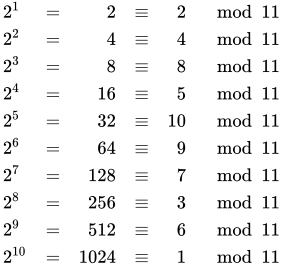
Als Beispiel diene die Primzahl p = 11 {\textstyle p=11} {\textstyle p=11} und die zugehörige prime Restklassengruppe G = ( Z / 11 Z ) × = { 1 , 2 , … , 10 } {\textstyle G=(\mathbb {Z} /11\mathbb {Z} )^{\times }=\{1,2,\dotsc ,10\}} {\textstyle G=(\mathbb {Z} /11\mathbb {Z} )^{\times }=\{1,2,\dotsc ,10\}}. Zur Primitivwurzel g = 2 {\textstyle g=2} {\textstyle g=2} wird nun die Wertetabelle der diskreten Exponentiation bestimmt.

2 1 = 2 ≡ 2 mod 11 2 2 = 4 ≡ 4 mod 11 2 3 = 8 ≡ 8 mod 11 2 4 = 16 ≡ 5 mod 11 2 5 = 32 ≡ 10 mod 11 2 6 = 64 ≡ 9 mod 11 2 7 = 128 ≡ 7 mod 11 2 8 = 256 ≡ 3 mod 11 2 9 = 512 ≡ 6 mod 11 2 10 = 1024 ≡ 1 mod 11 {\textstyle {\begin{array}{lcrlrl}2^{1}&=&2&\equiv &2&\mod {11}\\2^{2}&=&4&\equiv &4&\mod {11}\\2^{3}&=&8&\equiv &8&\mod {11}\\2^{4}&=&16&\equiv &5&\mod {11}\\2^{5}&=&32&\equiv &10&\mod {11}\\2^{6}&=&64&\equiv &9&\mod {11}\\2^{7}&=&128&\equiv &7&\mod {11}\\2^{8}&=&256&\equiv &3&\mod {11}\\2^{9}&=&512&\equiv &6&\mod {11}\\2^{10}&=&1024&\equiv &1&\mod {11}\end{array}}} {\textstyle {\begin{array}{lcrlrl}2^{1}&=&2&\equiv &2&\mod {11}\\2^{2}&=&4&\equiv &4&\mod {11}\\2^{3}&=&8&\equiv &8&\mod {11}\\2^{4}&=&16&\equiv &5&\mod {11}\\2^{5}&=&32&\equiv &10&\mod {11}\\2^{6}&=&64&\equiv &9&\mod {11}\\2^{7}&=&128&\equiv &7&\mod {11}\\2^{8}&=&256&\equiv &3&\mod {11}\\2^{9}&=&512&\equiv &6&\mod {11}\\2^{10}&=&1024&\equiv &1&\mod {11}\end{array}}}
a {\textstyle a} {\textstyle a} 1 2 3 4 5 6 7 8 9 10
2 a mod 11 {\textstyle 2^{a}\mod 11} {\textstyle 2^{a}\mod 11} 2 4 8 5 10 9 7 3 6 1

Dass es sich bei g {\displaystyle g} {\displaystyle g} tatsächlich um eine Primitivwurzel modulo 11 handelt, ist an den paarweise verschiedenen diskreten Potenzen erkennbar. Mit anderen Worten, die gesamte prime Restklassengruppe kann mithilfe der diskreten Potenzen von g {\displaystyle g} {\displaystyle g} erzeugt werden. Durch Vertauschen der Zeilen und Sortieren erhält man die Wertetabelle des diskreten Logarithmus.

x {\textstyle x} {\textstyle x} 1 2 3 4 5 6 7 8 9 10
log 2 ⁡ x {\textstyle \log _{2}x} {\textstyle \log _{2}x} 10 1 8 2 4 9 7 3 6 5

Literatur

[Bearbeiten | Quelltext bearbeiten]
  • Erich Härtter: Wahrscheinlichkeitsrechnung, Statistik und mathematische Grundlagen. Begriffe, Definitionen und Formeln. Verlag Vandenhoeck & Ruprecht, Göttingen 1987, ISBN 3-525-40731-9.
Abgerufen von „https://de.teknopedia.teknokrat.ac.id/w/index.php?title=Diskreter_Logarithmus&oldid=254405196“
Kategorie:
  • Zahlentheorie

  • indonesia
  • Polski
  • العربية
  • Deutsch
  • English
  • Español
  • Français
  • Italiano
  • مصرى
  • Nederlands
  • 日本語
  • Português
  • Sinugboanong Binisaya
  • Svenska
  • Українська
  • Tiếng Việt
  • Winaray
  • 中文
  • Русский
Sunting pranala
Pusat Layanan

UNIVERSITAS TEKNOKRAT INDONESIA | ASEAN's Best Private University
Jl. ZA. Pagar Alam No.9 -11, Labuhan Ratu, Kec. Kedaton, Kota Bandar Lampung, Lampung 35132
Phone: (0721) 702022
Email: pmb@teknokrat.ac.id