Technopedia Center
PMB University Brochure
Faculty of Engineering and Computer Science
S1 Informatics S1 Information Systems S1 Information Technology S1 Computer Engineering S1 Electrical Engineering S1 Civil Engineering

faculty of Economics and Business
S1 Management S1 Accountancy

Faculty of Letters and Educational Sciences
S1 English literature S1 English language education S1 Mathematics education S1 Sports Education
  • Registerasi
  • Brosur UTI
  • Kip Scholarship Information
  • Performance
  1. Weltenzyklopädie
  2. Deflation (Mathematik) – Wikipedia
Deflation (Mathematik) – Wikipedia 👆 Click Here!
aus Wikipedia, der freien Enzyklopädie

Deflation bezeichnet eine Technik aus der numerischen Mathematik, mit der eine Matrix A ∈ C n × n {\displaystyle A\in \mathbb {C} ^{n\times n}} {\displaystyle A\in \mathbb {C} ^{n\times n}} in Blockdreiecksform gebracht wird, so dass das Spektrum von A {\displaystyle A} {\displaystyle A} gerade die Vereinigung der Spektren der Diagonalblöcke ist.

Deflationsprinzip

[Bearbeiten | Quelltext bearbeiten]

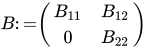
Sei F ∈ End ⁡ ( V ) {\displaystyle F\in \operatorname {End} (V)} {\displaystyle F\in \operatorname {End} (V)} ein Endomorphismus und A ∈ C n × n {\displaystyle A\in \mathbb {C} ^{n\times n}} {\displaystyle A\in \mathbb {C} ^{n\times n}} die zugehörige Abbildungsmatrix. Durch Basiswechsel kann diese Matrix in eine Matrix B {\displaystyle B} {\displaystyle B} der Form

B : = ( B 11 B 12 0 B 22 ) {\displaystyle B\colon {=}{\begin{pmatrix}B_{11}&B_{12}\\0&B_{22}\end{pmatrix}}} {\displaystyle B\colon {=}{\begin{pmatrix}B_{11}&B_{12}\\0&B_{22}\end{pmatrix}}}

mit B i i ∈ C k i × k i {\displaystyle B_{ii}\in \mathbb {C} ^{k_{i}\times k_{i}}} {\displaystyle B_{ii}\in \mathbb {C} ^{k_{i}\times k_{i}}} für i ∈ { 1 , 2 } {\displaystyle i\in \{1,2\}} {\displaystyle i\in \{1,2\}} und k 1 + k 2 = n {\displaystyle k_{1}+k_{2}=n} {\displaystyle k_{1}+k_{2}=n} transformiert werden. Für die Spektren σ ( B i i ) {\displaystyle \sigma (B_{ii})} {\displaystyle \sigma (B_{ii})} gilt

σ ( A ) = σ ( B 11 ) ∪ σ ( B 22 ) . {\displaystyle \sigma (A)=\sigma (B_{11})\cup \sigma (B_{22}).} {\displaystyle \sigma (A)=\sigma (B_{11})\cup \sigma (B_{22}).}

Anstelle des ( n × n ) {\displaystyle (n\times n)} {\displaystyle (n\times n)}-Eigenwertproblems A x = λ x {\displaystyle Ax=\lambda x} {\displaystyle Ax=\lambda x} kann man also die zwei kleineren Eigenwertprobleme

B i i y = λ y , i = 1 , 2 {\displaystyle B_{ii}y=\lambda y,\quad i=1,2} {\displaystyle B_{ii}y=\lambda y,\quad i=1,2}

lösen. Diese Methode kann man iterativ fortsetzen.

Deflation durch Ähnlichkeitstransformation

[Bearbeiten | Quelltext bearbeiten]

Theoretische Grundlage

[Bearbeiten | Quelltext bearbeiten]

Sei A ∈ C n × n {\displaystyle A\in \mathbb {C} ^{n\times n}} {\displaystyle A\in \mathbb {C} ^{n\times n}} eine quadratische Matrix und ( λ , v ) {\displaystyle (\lambda ,v)} {\displaystyle (\lambda ,v)} ein Eigenpaar von A {\displaystyle A} {\displaystyle A} bestehend aus dem Eigenwert λ ∈ C {\displaystyle \lambda \in \mathbb {C} } {\displaystyle \lambda \in \mathbb {C} } und einem dazugehörigen Eigenvektor v ∈ C n {\displaystyle v\in \mathbb {C} ^{n}} {\displaystyle v\in \mathbb {C} ^{n}}. Dieses Eigenpaar kann man beispielsweise durch die Potenzmethode erhalten. Die Matrix A {\displaystyle A} {\displaystyle A} wird nun mittels der Ähnlichkeitstransformation

B : = T − 1 A T {\displaystyle B\colon {=}T^{-1}AT} {\displaystyle B\colon {=}T^{-1}AT}

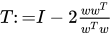
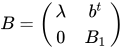
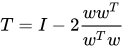
in eine Matrix B {\displaystyle B} {\displaystyle B} überführt. Die Transformationsmatrix T {\displaystyle T} {\displaystyle T} ist gegeben durch T : = I − 2 w w T w T w {\displaystyle T\colon {=}I-2{\tfrac {ww^{T}}{w^{T}w}}} {\displaystyle T\colon {=}I-2{\tfrac {ww^{T}}{w^{T}w}}} mit w = v + ‖ v ‖ 2 e 1 {\displaystyle w=v+\|v\|_{2}e_{1}} {\displaystyle w=v+\|v\|_{2}e_{1}}, wobei I {\displaystyle I} {\displaystyle I} die Einheitsmatrix und e 1 : = ( 1 0 … 0 ) T {\displaystyle e_{1}\colon {=}{\begin{pmatrix}1&0&\ldots &0\end{pmatrix}}^{T}} {\displaystyle e_{1}\colon {=}{\begin{pmatrix}1&0&\ldots &0\end{pmatrix}}^{T}} ist. Diese spezielle Basistransformation ist eine Householdertransformation. Daher gilt T = T − 1 {\displaystyle T=T^{-1}} {\displaystyle T=T^{-1}} und die Matrix B {\displaystyle B} {\displaystyle B} hat die Gestalt

B = ( λ b t 0 B 1 ) {\displaystyle B={\begin{pmatrix}\lambda &b^{t}\\0&B_{1}\end{pmatrix}}} {\displaystyle B={\begin{pmatrix}\lambda &b^{t}\\0&B_{1}\end{pmatrix}}}.

Diese Matrix hat dieselben Eigenwerte wie die Matrix A {\displaystyle A} {\displaystyle A}. Nun kann man wieder die Potenzmethode auf die Matrix B 1 {\displaystyle B_{1}} {\displaystyle B_{1}} anwenden und erhält so iterativ alle Eigenwerte.

Zahlenbeispiel

[Bearbeiten | Quelltext bearbeiten]

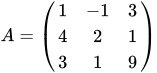
Sei

A = ( 1 − 1 3 4 2 1 3 1 9 ) {\displaystyle A={\begin{pmatrix}1&-1&3\\4&2&1\\3&1&9\end{pmatrix}}} {\displaystyle A={\begin{pmatrix}1&-1&3\\4&2&1\\3&1&9\end{pmatrix}}}

Durch die Potenzmethode erhält man ( λ 1 , v ) = ( 10.22459 , ( 0.2585012 0.3343480 0.9063049 ) T ) {\displaystyle (\lambda _{1},v)=\left(10.22459,{\begin{pmatrix}0.2585012&0.3343480&0.9063049\end{pmatrix}}^{T}\right)} {\displaystyle (\lambda _{1},v)=\left(10.22459,{\begin{pmatrix}0.2585012&0.3343480&0.9063049\end{pmatrix}}^{T}\right)} als Eigenpaar von A {\displaystyle A} {\displaystyle A}. Nun berechnet man die Transformationsmatrix T {\displaystyle T} {\displaystyle T}. Es ist

T = I − 2 w w T w T w {\displaystyle T=I-2{\frac {ww^{T}}{w^{T}w}}} {\displaystyle T=I-2{\frac {ww^{T}}{w^{T}w}}},

wobei w = v + ‖ v ‖ 2 e 1 {\displaystyle w=v+\|v\|_{2}e_{1}} {\displaystyle w=v+\|v\|_{2}e_{1}} ist.

Man erhält

T = ( − 0.258501 − 0.3343480 − 0.9063049 − 0.3343480 0.9111732 − 0.2407795 − 0.9063049 − 0.2407795 0.3473280 ) {\displaystyle T={\begin{pmatrix}-0.258501&-0.3343480&-0.9063049\\-0.3343480&0.9111732&-0.2407795\\-0.9063049&-0.2407795&0.3473280\end{pmatrix}}} {\displaystyle T={\begin{pmatrix}-0.258501&-0.3343480&-0.9063049\\-0.3343480&0.9111732&-0.2407795\\-0.9063049&-0.2407795&0.3473280\end{pmatrix}}}

und somit

T A T = ( 10.22459 3.5492494 0.5352000 0 − 1.5051646 − 2.3002829 0 1.7142389 0.2805751 ) {\displaystyle TAT={\begin{pmatrix}10.22459&3.5492494&0.5352000\\0&-1.5051646&-2.3002829\\0&1.7142389&0.2805751\end{pmatrix}}} {\displaystyle TAT={\begin{pmatrix}10.22459&3.5492494&0.5352000\\0&-1.5051646&-2.3002829\\0&1.7142389&0.2805751\end{pmatrix}}}

Die Eigenwerte der Matrix

C = ( − 1.5051646 − 2.3002829 1.7142389 0.2805751 ) {\displaystyle C={\begin{pmatrix}-1.5051646&-2.3002829\\1.7142389&0.2805751\end{pmatrix}}} {\displaystyle C={\begin{pmatrix}-1.5051646&-2.3002829\\1.7142389&0.2805751\end{pmatrix}}}

sind λ 2 = − 0.6122947 + 1.7737021 i {\displaystyle \lambda _{2}=-0.6122947+1.7737021i} {\displaystyle \lambda _{2}=-0.6122947+1.7737021i} und λ 3 = − 0.6122947 − 1.7737021 i {\displaystyle \lambda _{3}=-0.6122947-1.7737021i} {\displaystyle \lambda _{3}=-0.6122947-1.7737021i} somit ist

σ ( A ) = { 10.22459 , − 0.6122947 + 1.7737021 i , − 0.6122947 − 1.7737021 i } {\displaystyle \sigma (A)=\{10.22459,-0.6122947+1.7737021i,-0.6122947-1.7737021i\}} {\displaystyle \sigma (A)=\{10.22459,-0.6122947+1.7737021i,-0.6122947-1.7737021i\}}

Literatur

[Bearbeiten | Quelltext bearbeiten]
  • Martin Hanke-Bourgeois: Grundlagen der Numerischen Mathematik und des Wissenschaftlichen Rechnens. 1. Auflage, B. G. Teubner, Stuttgart 2002, ISBN 978-3-519-00356-4.
  • Robert Schaback, Helmut Werner: Numerische Mathematik. Vierte vollständig überarbeitete Auflage, Springer Verlag Berlin Heidelberg GmbH, Berlin Heidelberg 1992, ISBN 978-3-540-54738-9.
  • Willi Törnig: Numerische Mathematik für Ingenieure und Physiker. Band 1, Springer Verlag Berlin Heidelberg, Berlin Heidelberg 1979.

Siehe auch

[Bearbeiten | Quelltext bearbeiten]
  • Inverse Iteration

Weblinks

[Bearbeiten | Quelltext bearbeiten]
  • Grundlagen der Numerischen Mathematik (abgerufen am 8. September 2016)
  • Einführung in die Numerische Mathematik (abgerufen am 8. September 2016)
  • Nichtperiodische Pflasterungen mit ganzzahligem Inflationsfaktor (abgerufen am 8. September 2016)
Abgerufen von „https://de.teknopedia.teknokrat.ac.id/w/index.php?title=Deflation_(Mathematik)&oldid=236892683“
Kategorie:
  • Numerische lineare Algebra

  • indonesia
  • Polski
  • العربية
  • Deutsch
  • English
  • Español
  • Français
  • Italiano
  • مصرى
  • Nederlands
  • 日本語
  • Português
  • Sinugboanong Binisaya
  • Svenska
  • Українська
  • Tiếng Việt
  • Winaray
  • 中文
  • Русский
Sunting pranala
Pusat Layanan

UNIVERSITAS TEKNOKRAT INDONESIA | ASEAN's Best Private University
Jl. ZA. Pagar Alam No.9 -11, Labuhan Ratu, Kec. Kedaton, Kota Bandar Lampung, Lampung 35132
Phone: (0721) 702022
Email: pmb@teknokrat.ac.id