Arkusfunktionen (von lat. arcus „Bogen “), auch zyklometrische Funktionen genannt, sind, wie es ihre alternative Bezeichnung als inverse Winkelfunktionen andeutet, Umkehrfunktionen trigonometrischer Funktionen – die Arkusfunktionen liefern also zu einem gegebenen Winkelfunktionswert den zugehörigen Winkel .
Zu jeder der sechs Winkelfunktionen gibt es eine Arkusfunktion, die in mathematischen Formeln und Gleichungen durch ein vorangestelltes
arc
{\displaystyle \operatorname {arc} }
a
{\displaystyle \operatorname {a} }
⟨
−
1
⟩
{\displaystyle ^{\langle {-}1\rangle }}
Iteration , also die Umkehrfunktion, der Winkelfunktion handelt. Leider werden die spitzen Klammern oft weggelassen, wodurch eine Schreibung
−
1
{\displaystyle ^{-1}}
Kehrwert verwechselt werden kann.
Winkelfunktion
Arkusfunktion
Kürzel
als minus erste Iteration
Sinus
Arkussinus
arcsin
{\displaystyle \arcsin }
asin
{\displaystyle \operatorname {asin} }
sin
⟨
−
1
⟩
{\displaystyle \sin ^{\langle {-}1\rangle }}
sin
−
1
{\displaystyle \sin ^{-1}}
Kosinus
Arkuskosinus
arccos
{\displaystyle \arccos }
acos
{\displaystyle \operatorname {acos} }
cos
⟨
−
1
⟩
{\displaystyle \cos ^{\langle {-}1\rangle }}
cos
−
1
{\displaystyle \cos ^{-1}}
Tangens
Arkustangens
arctan
{\displaystyle \arctan }
atan
{\displaystyle \operatorname {atan} }
tan
⟨
−
1
⟩
{\displaystyle \tan ^{\langle {-}1\rangle }}
tan
−
1
{\displaystyle \tan ^{-1}}
Kotangens
Arkuskotangens
arccot
{\displaystyle \operatorname {arccot} }
acot
{\displaystyle \operatorname {acot} }
cot
⟨
−
1
⟩
{\displaystyle \cot ^{\langle {-}1\rangle }}
cot
−
1
{\displaystyle \cot ^{-1}}
Sekans
Arkussekans
arcsec
{\displaystyle \operatorname {arcsec} }
sec
⟨
−
1
⟩
{\displaystyle \sec ^{\langle {-}1\rangle }}
sec
−
1
{\displaystyle \sec ^{-1}}
Kosekans
Arkuskosekans
arccsc
{\displaystyle \operatorname {arccsc} }
csc
⟨
−
1
⟩
{\displaystyle \csc ^{\langle {-}1\rangle }}
csc
−
1
{\displaystyle \csc ^{-1}}
Die Hauptwerte der arcsin(x )- (rot) und arccos(x )-Funktionen (blau) Die Hauptwerte der arctan(x )- (rot) und arccot(x )-Funktionen (blau)
Die Hauptwerte der arcsec(x )- and arccsc(x )-Funktion
Riemannsche Fläche des komplexen Logarithmus . Die Blätter haben einen Abstand von
2
π
{\displaystyle 2\pi }
Da die trigonometrischen Funktionen periodische Funktionen sind, sind sie zunächst einmal nicht invertierbar . Beschränkt man sich jedoch auf ein Monotonie intervall der jeweiligen Ausgangsfunktion, z. B. auf das Intervall
[
−
π
/
2
,
π
/
2
]
{\displaystyle [-\pi /2,\pi /2]}
[
0
,
π
]
{\displaystyle [0,\pi ]}
eingeschränkte Funktion sehr wohl invertiert werden. Allerdings überdecken die Monotonieintervalle jeweils nur eine halbe Periode, siehe Abbildung oben. Kennt man jedoch sowohl den Sinus als auch den Kosinus eines Winkels (allgemeiner: komplexe Komponenten), so kann man den Winkel bis auf ganze Perioden
(
2
π
)
{\displaystyle (2\pi )}
arctan2 für die Berechnung.
Siehe auch: Trigonometrische Funktion: Beziehungen zwischen den Funktionen
Arkusfunktionen lassen sich wie folgt ineinander umrechnen (wobei
sgn
{\displaystyle \operatorname {sgn} }
Vorzeichenfunktion bezeichnet):
arcsin
arccos
arctan
arccot
arcsec
arccsc
arcsin(x)
arcsin
(
x
)
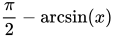
{\displaystyle \arcsin(x)}
π
2
−
arccos
(
x
)
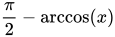
{\displaystyle {\frac {\pi }{2}}-\arccos(x)}
arctan
(
x
1
−
x
2
)
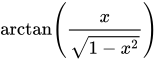
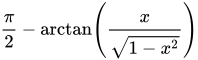
{\displaystyle \arctan \left({\frac {x}{\sqrt {1-x^{2}}}}\right)}
π
2
−
arccot
(
x
1
−
x
2
)
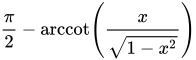
{\displaystyle {\frac {\pi }{2}}-\operatorname {arccot} \left({\frac {x}{\sqrt {1-x^{2}}}}\right)}
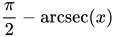
π
2
−
arcsec
(
1
x
)
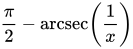
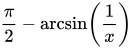
{\displaystyle {\frac {\pi }{2}}-\operatorname {arcsec} \left({\frac {1}{x}}\right)}
arccsc
(
1
x
)
{\displaystyle \operatorname {arccsc} \left({\frac {1}{x}}\right)}
arccos(x)
π
2
−
arcsin
(
x
)
{\displaystyle {\frac {\pi }{2}}-\arcsin(x)}
arccos
(
x
)
{\displaystyle \arccos(x)}
π
2
−
arctan
(
x
1
−
x
2
)
{\displaystyle {\frac {\pi }{2}}-\arctan \left({\frac {x}{\sqrt {1-x^{2}}}}\right)}
arccot
(
x
1
−
x
2
)
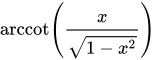
{\displaystyle \operatorname {arccot} \left({\frac {x}{\sqrt {1-x^{2}}}}\right)}
arcsec
(
1
x
)
{\displaystyle \operatorname {arcsec} \left({\frac {1}{x}}\right)}
π
2
−
arccsc
(
1
x
)
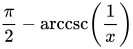
{\displaystyle {\frac {\pi }{2}}-\operatorname {arccsc} \left({\frac {1}{x}}\right)}
arctan(x)
arcsin
(
x
1
+
x
2
)
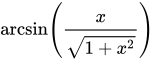
{\displaystyle \arcsin \left({\frac {x}{\sqrt {1+x^{2}}}}\right)}
π
2
−
arccos
(
x
1
+
x
2
)
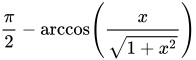
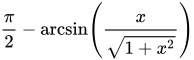
{\displaystyle {\frac {\pi }{2}}-\arccos \left({\frac {x}{\sqrt {1+x^{2}}}}\right)}
arctan
(
x
)
{\displaystyle \arctan(x)}
π
2
−
arccot
(
x
)
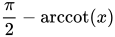
{\displaystyle {\frac {\pi }{2}}-\operatorname {arccot}(x)}
π
2
−
arcsec
(
1
+
x
2
x
)
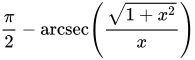
{\displaystyle {\frac {\pi }{2}}-\operatorname {arcsec} \left({\frac {\sqrt {1+x^{2}}}{x}}\right)}
arccsc
(
1
+
x
2
x
)
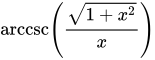
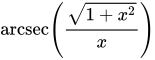
{\displaystyle \operatorname {arccsc} \left({\frac {\sqrt {1+x^{2}}}{x}}\right)}
arccot(x)
π
2
−
arcsin
(
x
1
+
x
2
)
{\displaystyle {\frac {\pi }{2}}-\arcsin \left({\frac {x}{\sqrt {1+x^{2}}}}\right)}
arccos
(
x
1
+
x
2
)
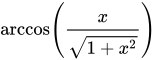
{\displaystyle \arccos \left({\frac {x}{\sqrt {1+x^{2}}}}\right)}
π
2
−
arctan
(
x
)
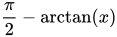
{\displaystyle {\frac {\pi }{2}}-\arctan(x)}
arccot
(
x
)
{\displaystyle \operatorname {arccot}(x)}
arcsec
(
1
+
x
2
x
)
{\displaystyle \operatorname {arcsec} \left({\frac {\sqrt {1+x^{2}}}{x}}\right)}
π
2
−
arccsc
(
1
+
x
2
x
)
{\displaystyle {\frac {\pi }{2}}-\operatorname {arccsc} \left({\frac {\sqrt {1+x^{2}}}{x}}\right)}
arcsec(x)
π
2
−
arcsin
(
1
x
)
{\displaystyle {\frac {\pi }{2}}-\arcsin \left({\frac {1}{x}}\right)}
arccos
(
1
x
)
{\displaystyle \arccos \left({\frac {1}{x}}\right)}
π
2
−
arctan
(
sgn
(
x
)
x
2
−
1
)
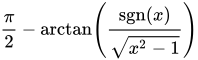
{\displaystyle {\frac {\pi }{2}}-\arctan \left({\frac {\operatorname {sgn}(x)}{\sqrt {x^{2}-1}}}\right)}
arccot
(
sgn
(
x
)
x
2
−
1
)
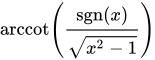
{\displaystyle \operatorname {arccot} \left({\frac {\operatorname {sgn}(x)}{\sqrt {x^{2}-1}}}\right)}
arcsec
(
x
)
{\displaystyle \operatorname {arcsec}(x)}
π
2
−
arccsc
(
x
)
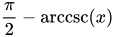
{\displaystyle {\frac {\pi }{2}}-\operatorname {arccsc}(x)}
arccsc(x)
arcsin
(
1
x
)
{\displaystyle \arcsin \left({\frac {1}{x}}\right)}
π
2
−
arccos
(
1
x
)
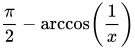
{\displaystyle {\frac {\pi }{2}}-\arccos \left({\frac {1}{x}}\right)}
arctan
(
sgn
(
x
)
x
2
−
1
)
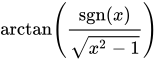
{\displaystyle \arctan \left({\frac {\operatorname {sgn}(x)}{\sqrt {x^{2}-1}}}\right)}
π
2
−
arccot
(
sgn
(
x
)
x
2
−
1
)
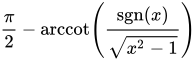
{\displaystyle {\frac {\pi }{2}}-\operatorname {arccot} \left({\frac {\operatorname {sgn}(x)}{\sqrt {x^{2}-1}}}\right)}
π
2
−
arcsec
(
x
)
{\displaystyle {\frac {\pi }{2}}-\operatorname {arcsec}(x)}
arccsc
(
x
)
{\displaystyle \operatorname {arccsc}(x)}
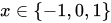
Bei den für
x
∈
{
−
1
,
0
,
1
}
{\displaystyle x\in \{-1,0,1\}}
arcsin
(
−
1
)
=
lim
x
→
−
1
arctan
(
x
1
−
x
2
)
=
lim
y
→
−
∞
arctan
(
y
)
=
−
π
2
{\displaystyle \arcsin(-1)=\lim _{x\to -1}\arctan \left({\frac {x}{\sqrt {1-x^{2}}}}\right)=\lim _{y\to -\infty }\arctan(y)=-{\frac {\pi }{2}}}


![{\displaystyle [-\pi /2,\pi /2]}](https://wikimedia.org/api/rest_v1/media/math/render/svg/cd702a5a7041be010f870c0e23750d98ba9919f5)
![{\displaystyle [0,\pi ]}](https://wikimedia.org/api/rest_v1/media/math/render/svg/3e2a912eda6ef1afe46a81b518fe9da64a832751)