Technopedia Center
PMB University Brochure
Faculty of Engineering and Computer Science
S1 Informatics S1 Information Systems S1 Information Technology S1 Computer Engineering S1 Electrical Engineering S1 Civil Engineering

faculty of Economics and Business
S1 Management S1 Accountancy

Faculty of Letters and Educational Sciences
S1 English literature S1 English language education S1 Mathematics education S1 Sports Education
  • Registerasi
  • Brosur UTI
  • Kip Scholarship Information
  • Performance
  1. Weltenzyklopädie
  2. Ortsoperator – Wikipedia
Ortsoperator – Wikipedia 👆 Click Here!
aus Wikipedia, der freien Enzyklopädie

Der Ortsoperator gehört in der Quantenmechanik zur Ortsmessung von Teilchen.

Der physikalische Zustand Ψ {\displaystyle \Psi } {\displaystyle \Psi } eines Teilchens ist in der Quantenmechanik mathematisch gegeben durch den zugehörigen Vektor eines Hilbertraumes H. Dieser Zustand wird folglich in der Bra-Ket-Notation durch den Vektor | Ψ ⟩ {\displaystyle |\Psi \rangle } {\displaystyle |\Psi \rangle } beschrieben. Die Observablen werden durch selbstadjungierte Operatoren auf H dargestellt.

Speziell ist der Ortsoperator die Zusammenfassung der drei Observablen x ^ = ( x ^ 1 , x ^ 2 , x ^ 3 ) {\displaystyle {\hat {\mathbf {x} }}=({\hat {x}}_{1},{\hat {x}}_{2},{\hat {x}}_{3})} {\displaystyle {\hat {\mathbf {x} }}=({\hat {x}}_{1},{\hat {x}}_{2},{\hat {x}}_{3})}, so dass

E ( x ^ j ) = ⟨ x ^ j Ψ , Ψ ⟩ H   , j = 1 , 2 , 3 {\displaystyle E({\hat {x}}_{j})={\langle {\hat {x}}_{j}\,\Psi ,\Psi \rangle }_{\mathrm {H} }\ ,\quad j=1,2,3} {\displaystyle E({\hat {x}}_{j})={\langle {\hat {x}}_{j}\,\Psi ,\Psi \rangle }_{\mathrm {H} }\ ,\quad j=1,2,3}

der Mittelwert (Erwartungswert) der Messergebnisse der j-ten Ortskoordinate des Teilchens im Zustand Ψ {\displaystyle \Psi } {\displaystyle \Psi } ist.

Definition und Eigenschaften

[Bearbeiten | Quelltext bearbeiten]
  • Die drei Ortsoperatoren sind selbstadjungierte Operatoren x ^ j {\displaystyle {\hat {x}}_{j}} {\displaystyle {\hat {x}}_{j}}, die mit den ebenfalls selbstadjungierten Impulsoperatoren p ^ k {\displaystyle {\hat {p}}_{k}} {\displaystyle {\hat {p}}_{k}} die folgenden kanonischen Vertauschungsrelationen erfüllen:
[ x ^ j , p ^ k ] = i ℏ δ j k   , [ x ^ j , x ^ k ] = 0 = [ p ^ j , p ^ k ]   , j , k ∈ { 1 , 2 , 3 } {\displaystyle [{\hat {x}}_{j},{\hat {p}}_{k}]=\mathrm {i} \,\hbar \,\delta _{jk}\ ,\quad [{\hat {x}}_{j},{\hat {x}}_{k}]=0=[{\hat {p}}_{j},{\hat {p}}_{k}]\ ,\quad j,k\in \{1,2,3\}} {\displaystyle [{\hat {x}}_{j},{\hat {p}}_{k}]=\mathrm {i} \,\hbar \,\delta _{jk}\ ,\quad [{\hat {x}}_{j},{\hat {x}}_{k}]=0=[{\hat {p}}_{j},{\hat {p}}_{k}]\ ,\quad j,k\in \{1,2,3\}}
  • Daraus folgt, dass die drei Ortskoordinaten gemeinsam messbar sind und dass ihr Spektrum (Bereich der möglichen Messwerte) aus dem gesamten Raum R 3 {\displaystyle \mathbb {R} ^{3}} {\displaystyle \mathbb {R} ^{3}} besteht. Die möglichen Orte sind also nicht quantisiert, sondern kontinuierlich.

Ortsdarstellung

[Bearbeiten | Quelltext bearbeiten]

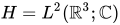
Die Ortsdarstellung ist durch die Spektraldarstellung des Ortsoperators definiert. Der Hilbertraum H = L 2 ( R 3 ; C ) {\displaystyle H=L^{2}(\mathbb {R} ^{3};\mathbb {C} )} {\displaystyle H=L^{2}(\mathbb {R} ^{3};\mathbb {C} )} ist der Raum der quadratintegrierbaren komplexen Funktionen des Ortsraums R 3 {\displaystyle \mathbb {R} ^{3}} {\displaystyle \mathbb {R} ^{3}}, jeder Zustand Ψ {\displaystyle \Psi } {\displaystyle \Psi } ist durch eine Ortswellenfunktion ψ ( x ) {\displaystyle \psi (\mathbf {x} )} {\displaystyle \psi (\mathbf {x} )} gegeben.
Die Ortsoperatoren x ^ = ( x ^ 1 , x ^ 2 , x ^ 3 ) {\displaystyle {\hat {\mathbf {x} }}=({\hat {x}}_{1},{\hat {x}}_{2},{\hat {x}}_{3})} {\displaystyle {\hat {\mathbf {x} }}=({\hat {x}}_{1},{\hat {x}}_{2},{\hat {x}}_{3})} sind die Multiplikationsoperatoren mit den Koordinatenfunktionen, d. h. der Ortsoperator x ^ j {\displaystyle {\hat {x}}_{j}} {\displaystyle {\hat {x}}_{j}} wirkt auf Ortswellenfunktionen ψ ( x ) {\displaystyle \psi (\mathbf {x} )} {\displaystyle \psi (\mathbf {x} )} durch die Multiplikation der Wellenfunktion mit der Koordinatenfunktion x j {\displaystyle x_{j}} {\displaystyle x_{j}}

( x ^ j ψ ) ( x ) = x j ⋅ ψ ( x ) {\displaystyle ({\hat {x}}_{j}\,\psi )(\mathbf {x} )=x_{j}\cdot \psi (\mathbf {x} )} {\displaystyle ({\hat {x}}_{j}\,\psi )(\mathbf {x} )=x_{j}\cdot \psi (\mathbf {x} )}

Dieser Operator x ^ j {\displaystyle {\hat {x}}_{j}} {\displaystyle {\hat {x}}_{j}} ist als Multiplikationsoperator ein dicht definierter Operator und abgeschlossen. Er ist auf dem Unterraum D = { ψ ∈ H | x ⋅ ψ ∈ H } {\displaystyle D=\{\psi \in H\,|\,x\cdot \psi \in H\}} {\displaystyle D=\{\psi \in H\,|\,x\cdot \psi \in H\}} definiert, der in H dicht liegt.

Der Erwartungswert ist

E ( x ^ j ) = ⟨ x ^ j Ψ , Ψ ⟩ L 2 = ∫ R 3 x j ψ ( x ) ψ ( x ) ¯ d x = ∫ R 3 x j | ψ ( x ) | 2 d x {\displaystyle E({\hat {x}}_{j})={\langle {\hat {x}}_{j}\,\Psi ,\Psi \rangle }_{L^{2}}=\int _{\mathbb {R} ^{3}}x_{j}\,\psi (\mathbf {x} )\,{\overline {\psi (\mathbf {x} )}}\,\mathrm {d} x=\int _{\mathbb {R} ^{3}}x_{j}\,|\psi (\mathbf {x} )|^{2}\mathrm {d} x} {\displaystyle E({\hat {x}}_{j})={\langle {\hat {x}}_{j}\,\Psi ,\Psi \rangle }_{L^{2}}=\int _{\mathbb {R} ^{3}}x_{j}\,\psi (\mathbf {x} )\,{\overline {\psi (\mathbf {x} )}}\,\mathrm {d} x=\int _{\mathbb {R} ^{3}}x_{j}\,|\psi (\mathbf {x} )|^{2}\mathrm {d} x}

Der Impulsoperator wirkt auf Ortswellenfunktionen (bei geeigneter Wahl der Phasen) als Differentialoperator:
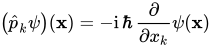
( p ^ k ψ ) ( x ) = − i ℏ ∂ ∂ x k ψ ( x ) {\displaystyle {\bigl (}{\hat {p}}_{k}\psi {\bigr )}(\mathbf {x} )=-\mathrm {i} \,\hbar \,{\frac {\partial }{\partial x_{k}}}\psi (\mathbf {x} )} {\displaystyle {\bigl (}{\hat {p}}_{k}\psi {\bigr )}(\mathbf {x} )=-\mathrm {i} \,\hbar \,{\frac {\partial }{\partial x_{k}}}\psi (\mathbf {x} )}

Eigenfunktionen

[Bearbeiten | Quelltext bearbeiten]

Die Eigenfunktionen des Ortsoperators müssen die Eigenwertgleichung

( x ^ ψ x 0 ) ( x ) = x 0 ⋅ ψ x 0 ( x ) {\displaystyle ({\hat {x}}\,\psi _{\mathbf {x_{0}} })(\mathbf {x} )=\mathbf {x_{0}} \cdot \psi _{\mathbf {x_{0}} }(\mathbf {x} )} {\displaystyle ({\hat {x}}\,\psi _{\mathbf {x_{0}} })(\mathbf {x} )=\mathbf {x_{0}} \cdot \psi _{\mathbf {x_{0}} }(\mathbf {x} )}

erfüllen, wobei ψ x 0 ( x ) {\displaystyle \psi _{\mathbf {x_{0}} }(\mathbf {x} )} {\displaystyle \psi _{\mathbf {x_{0}} }(\mathbf {x} )} die Eigenfunktion des Ortsoperators zum Eigenwert x 0 {\displaystyle \mathbf {x_{0}} } {\displaystyle \mathbf {x_{0}} } darstellt.

Die Eigenfunktionen ψ ( x 0 ) {\displaystyle \psi (\mathbf {x_{0}} )} {\displaystyle \psi (\mathbf {x_{0}} )} zum Ortsoperator entsprechen Delta-Distributionen: x ^ δ ( x − x 0 ) = x 0 δ ( x − x 0 ) {\displaystyle {\hat {\mathbf {x} }}\delta (\mathbf {x} -\mathbf {x_{0}} )=\mathbf {x_{0}} \delta (\mathbf {x} -\mathbf {x_{0}} )} {\displaystyle {\hat {\mathbf {x} }}\delta (\mathbf {x} -\mathbf {x_{0}} )=\mathbf {x_{0}} \delta (\mathbf {x} -\mathbf {x_{0}} )}

mit der Identität: f ( x ) δ ( x − x 0 ) = f ( x 0 ) δ ( x − x 0 ) {\displaystyle f(x)\delta (x-x_{0})=f(x_{0})\delta (x-x_{0})} {\displaystyle f(x)\delta (x-x_{0})=f(x_{0})\delta (x-x_{0})}

Impulsdarstellung

[Bearbeiten | Quelltext bearbeiten]

In der Impulsdarstellung wirkt der Impulsoperator multiplikativ auf Impulswellenfunktionen ψ ~ ( p ) {\displaystyle {\tilde {\psi }}(\mathbf {p} )} {\displaystyle {\tilde {\psi }}(\mathbf {p} )}

( p ^ k ψ ~ ) ( p ) = p k ⋅ ψ ~ ( p ) {\displaystyle ({\hat {p}}_{k}\,{\tilde {\psi }})(\mathbf {p} )=p_{k}\cdot {\tilde {\psi }}(\mathbf {p} )} {\displaystyle ({\hat {p}}_{k}\,{\tilde {\psi }})(\mathbf {p} )=p_{k}\cdot {\tilde {\psi }}(\mathbf {p} )}
und der Ortsoperator als Differentialoperator:
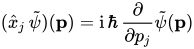
( x ^ j ψ ~ ) ( p ) = i ℏ ∂ ∂ p j ψ ~ ( p ) {\displaystyle ({\hat {x}}_{j}\,{\tilde {\psi }})(\mathbf {p} )=\mathrm {i} \,\hbar \,{\frac {\partial }{\partial p_{j}}}{\tilde {\psi }}(\mathbf {p} )} {\displaystyle ({\hat {x}}_{j}\,{\tilde {\psi }})(\mathbf {p} )=\mathrm {i} \,\hbar \,{\frac {\partial }{\partial p_{j}}}{\tilde {\psi }}(\mathbf {p} )}

Literatur

[Bearbeiten | Quelltext bearbeiten]
Siehe auch: Quantenmechanik und Mathematische Formulierung der Quantenmechanik
  • Jochen Pade: Quantenmechanik zu Fuß 1. Springer, Berlin, Heidelberg 2012, ISBN 978-3-642-25226-6, doi:10.1007/978-3-642-25227-3. 
Abgerufen von „https://de.teknopedia.teknokrat.ac.id/w/index.php?title=Ortsoperator&oldid=232469429“
Kategorien:
  • Quantenmechanik
  • Quantenchemie

  • indonesia
  • Polski
  • العربية
  • Deutsch
  • English
  • Español
  • Français
  • Italiano
  • مصرى
  • Nederlands
  • 日本語
  • Português
  • Sinugboanong Binisaya
  • Svenska
  • Українська
  • Tiếng Việt
  • Winaray
  • 中文
  • Русский
Sunting pranala
Pusat Layanan

UNIVERSITAS TEKNOKRAT INDONESIA | ASEAN's Best Private University
Jl. ZA. Pagar Alam No.9 -11, Labuhan Ratu, Kec. Kedaton, Kota Bandar Lampung, Lampung 35132
Phone: (0721) 702022
Email: pmb@teknokrat.ac.id


