Technopedia Center
PMB University Brochure
Faculty of Engineering and Computer Science
S1 Informatics S1 Information Systems S1 Information Technology S1 Computer Engineering S1 Electrical Engineering S1 Civil Engineering

faculty of Economics and Business
S1 Management S1 Accountancy

Faculty of Letters and Educational Sciences
S1 English literature S1 English language education S1 Mathematics education S1 Sports Education
  • Registerasi
  • Brosur UTI
  • Kip Scholarship Information
  • Performance
  1. Weltenzyklopädie
  2. Logistische Funktion – Wikipedia
Logistische Funktion – Wikipedia 👆 Click Here!
aus Wikipedia, der freien Enzyklopädie
Dieser Artikel ist eine Weiterleitung von Expit. Zum Arzneimittel Expit siehe Chemische Fabrik v. Heyden.
Logistische Funktion für den Fall G = 1 ; k = 1 ; f ( 0 ) = 0 , 5 {\displaystyle G=1\,;\,k=1\,;\,f(0)=0{,}5} {\displaystyle G=1\,;\,k=1\,;\,f(0)=0{,}5}

Die logistische Funktion charakterisiert eine stetige eindimensionale Wahrscheinlichkeitsverteilung (die logistische Verteilung) und ist eine funktionelle Darstellung von Sättigungsprozessen aus der Klasse der sogenannten Sigmoidfunktionen mit unbegrenzter zeitlicher Ausdehnung.

Der Graph der Funktion beschreibt eine S-förmige Kurve, ein Sigmoid. Heute ist der Name logistische Kurve eindeutig der S-Funktion zugeordnet, wohingegen noch bis ins 20. Jahrhundert gelegentlich auch der Logarithmus mit dem italienischen Namen der logistischen Kurve (curva logistica) belegt wurde.

Die Funktion wird manchmal auch mit Expit bezeichnet, da die Umkehrfunktion der logistischen Funktion die Logit-Funktion ist.

Beschreibung

[Bearbeiten | Quelltext bearbeiten]

Die logistische Funktion, wie sie sich aus der diskreten logistischen Gleichung ergibt, beschreibt den Zusammenhang zwischen der verstreichenden Zeit und einem Wachstum. Hierzu wird das Modell des exponentiellen Wachstums modifiziert durch eine sich mit dem Wachstum verbrauchende Ressource, die eine obere Schranke darstellt.

Zur Anfangszeit ist der Funktionswert nicht 0, sondern es gilt f ( 0 ) > 0 {\displaystyle f(0)>0} {\displaystyle f(0)>0}.

Es gilt:

  • Die obere Schranke G {\displaystyle G} {\displaystyle G} bildet eine Grenze für den Funktionswert f ( t ) {\displaystyle f(t)} {\displaystyle f(t)}.
  • Das Wachstum f ′ ( t ) {\displaystyle f'(t)} {\displaystyle f'(t)} ist proportional zu:
    • dem aktuellen Bestand f ( t ) {\displaystyle f(t)} {\displaystyle f(t)},
    • der noch vorhandenen Kapazität G − f ( t ) {\displaystyle G-f(t)} {\displaystyle G-f(t)}
    • und einer Wachstumskonstanten k {\displaystyle k} {\displaystyle k}.

Diese Entwicklung wird daher durch eine Bernoullische Differentialgleichung der Form

f ′ ( t ) = k ⋅ f ( t ) ⋅ ( G − f ( t ) ) {\displaystyle f'(t)=k\cdot f(t)\cdot \left(G-f(t)\right)} {\displaystyle f'(t)=k\cdot f(t)\cdot \left(G-f(t)\right)}

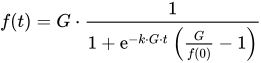
mit einer Proportionalitätskonstanten k {\displaystyle k} {\displaystyle k} beschrieben. Das Lösen dieser Differentialgleichung ergibt:

f ( t ) = G ⋅ 1 1 + e − k ⋅ G ⋅ t ( G f ( 0 ) − 1 ) {\displaystyle f(t)=G\cdot {\frac {1}{1+\mathrm {e} ^{-k\cdot G\cdot t}\left({\frac {G}{f(0)}}-1\right)}}} {\displaystyle f(t)=G\cdot {\frac {1}{1+\mathrm {e} ^{-k\cdot G\cdot t}\left({\frac {G}{f(0)}}-1\right)}}}
Logistische Funktion (blau) mit erster (rot) und zweiter Ableitung (schwarz)

Am Anfang ist das Wachstum klein, da die Population und somit die Zahl der sich vermehrenden Individuen gering ist. In der Mitte der Entwicklung (genauer: im Wendepunkt) wächst die Population am stärksten, bis sie durch die sich erschöpfenden Ressourcen gebremst wird. Die erste Ableitung der logistischen Funktion ist vom Typ einer Glockenkurve, d. h. am Wendepunkt hat das Wachstum das Maximum (= höchste Steigung von f) und gegen unendlich (-∞; +∞) strebt der Wert gegen Null, was ähnlich einer Gaußschen Normalverteilung aussieht, aber sich im Detail unterscheidet, vgl. auch mit Logit und Probit-Transformation.

Die beiden stationären Lösungen der Differentialgleichung sind f ≡ 0 {\displaystyle f\equiv 0} {\displaystyle f\equiv 0} und f ≡ G {\displaystyle f\equiv G} {\displaystyle f\equiv G}.

Anwendungen

[Bearbeiten | Quelltext bearbeiten]
Beispiel einer Epidemie: Krankheits- und Todesfälle (schwarz) im Verlauf der Ebolafieber-Epidemie in Westafrika bis Juli 2014 (annähernd logistische Funktionen)

Die logistische Gleichung beschreibt einen sehr häufig auftretenden Zusammenhang, wie der Beschreibung einer Population von Lebewesen, beispielsweise einer idealen Bakterien­population, die auf einem Bakteriennährboden begrenzter Größe wächst. Ein weiteres Beispiel ist (annähernd) die Verbreitung einer Infektionskrankheit mit anschließender permanenter Immunität, bei der mit der Zeit eine abnehmende Anzahl für die Infektionskrankheit anfällige Individuen übrig bleiben, siehe SI-Modell.

Die Funktion findet weit über den Modellen aus der Biologie hinaus Anwendung. Auch der Lebenszyklus eines Produktes im Markt kann mit der logistischen Funktion nachgebildet werden.[1] Weitere Anwendungsbereiche sind Wachstums- und Zerfallsprozesse in der Sprache (Sprachwandelgesetz, Piotrowski-Gesetz) sowie die Entwicklung im Erwerb der Muttersprache (Spracherwerbsgesetz).

Lösung der Differentialgleichung

[Bearbeiten | Quelltext bearbeiten]

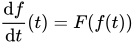
Sei F : R → R , t ↦ k t ( G − t ) {\displaystyle F\colon \mathbb {R} \to \mathbb {R} ,t\mapsto kt(G-t)} {\displaystyle F\colon \mathbb {R} \to \mathbb {R} ,t\mapsto kt(G-t)}. F {\displaystyle F} {\displaystyle F} ist stetig. Es gilt, die Differentialgleichung

d f d t ( t ) = F ( f ( t ) ) {\displaystyle {\frac {\mathrm {d} f}{\mathrm {d} t}}(t)=F(f(t))} {\displaystyle {\frac {\mathrm {d} f}{\mathrm {d} t}}(t)=F(f(t))}

zu lösen.

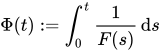
Die Differentialgleichung lässt sich mit dem Verfahren „Trennung der Variablen“ lösen. Es gilt F ( t ) ≠ 0 {\displaystyle F(t)\neq 0} {\displaystyle F(t)\neq 0} für alle t ∈ R {\displaystyle t\in \mathbb {R} } {\displaystyle t\in \mathbb {R} }, also ist die Abbildung

Φ ( t ) := ∫ 0 t 1 F ( s ) d s {\displaystyle \Phi (t):=\int _{0}^{t}{\frac {1}{F(s)}}\,{\mathrm {d} }s} {\displaystyle \Phi (t):=\int _{0}^{t}{\frac {1}{F(s)}}\,{\mathrm {d} }s}

auf den reellen Zahlen wohldefiniert.

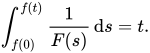
Nach der Trennung der Variablen ist die Lösung f {\displaystyle f} {\displaystyle f} der obigen Differentialgleichung also identisch mit der Lösung der Differentialgleichung

∫ f ( 0 ) f ( t ) 1 F ( s ) d s = t . {\displaystyle \int _{f(0)}^{f(t)}{\frac {1}{F(s)}}\,\mathrm {d} s=t.} {\displaystyle \int _{f(0)}^{f(t)}{\frac {1}{F(s)}}\,\mathrm {d} s=t.}

Durch Partialbruchzerlegung ergibt sich

∫ f ( 0 ) f ( t ) 1 F ( s ) d s = ∫ f ( 0 ) f ( t ) 1 k s ( G − s ) d s = 1 k G ∫ f ( 0 ) f ( t ) ( 1 s + 1 G − s ) d s . {\displaystyle \int _{f(0)}^{f(t)}{\frac {1}{F(s)}}\,\mathrm {d} s=\int _{f(0)}^{f(t)}{\frac {1}{ks(G-s)}}\,\mathrm {d} s={\frac {1}{kG}}\int _{f(0)}^{f(t)}\left({\frac {1}{s}}+{\frac {1}{G-s}}\right)\,\mathrm {d} s.} {\displaystyle \int _{f(0)}^{f(t)}{\frac {1}{F(s)}}\,\mathrm {d} s=\int _{f(0)}^{f(t)}{\frac {1}{ks(G-s)}}\,\mathrm {d} s={\frac {1}{kG}}\int _{f(0)}^{f(t)}\left({\frac {1}{s}}+{\frac {1}{G-s}}\right)\,\mathrm {d} s.}

Nach dem Hauptsatz der Differential- und Integralrechnung ist das obige Integral

= 1 k G ( ln ⁡ ( s ) − ln ⁡ ( G − s ) ) | s = f ( 0 ) s = f ( t ) = 1 k G ( ln ⁡ ( f ( t ) G − f ( t ) ) + c ) {\displaystyle =\left.{\frac {1}{kG}}{\bigg (}\ln(s)-\ln(G-s){\bigg )}\right|_{s=f(0)}^{s=f(t)}={\frac {1}{kG}}\left(\ln \left({\frac {f(t)}{G-f(t)}}\right)+c\right)} {\displaystyle =\left.{\frac {1}{kG}}{\bigg (}\ln(s)-\ln(G-s){\bigg )}\right|_{s=f(0)}^{s=f(t)}={\frac {1}{kG}}\left(\ln \left({\frac {f(t)}{G-f(t)}}\right)+c\right)}

wobei

c := − ln ⁡ f ( 0 ) G − f ( 0 ) = ln ⁡ ( G f ( 0 ) − 1 ) . {\displaystyle c:=-\ln {\frac {f(0)}{G-f(0)}}=\ln \left({\frac {G}{f(0)}}-1\right).} {\displaystyle c:=-\ln {\frac {f(0)}{G-f(0)}}=\ln \left({\frac {G}{f(0)}}-1\right).}

Es gilt also, die Funktionsgleichung

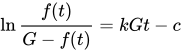
ln ⁡ f ( t ) G − f ( t ) = k G t − c {\displaystyle \ln {\frac {f(t)}{G-f(t)}}=kGt-c} {\displaystyle \ln {\frac {f(t)}{G-f(t)}}=kGt-c}

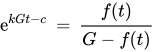
zu lösen, solange die f ( t ) {\displaystyle f(t)} {\displaystyle f(t)} zwischen 0 {\displaystyle 0} {\displaystyle 0} und G {\displaystyle G} {\displaystyle G} liegen, was wegen der Voraussetzung 0 < f ( 0 ) < G {\displaystyle 0<f(0)<G} {\displaystyle 0<f(0)<G} angenommen werden kann. Dabei ist ln {\displaystyle \ln } {\displaystyle \ln } der natürliche Logarithmus. Die Anwendung der Exponentialfunktion auf beiden Seiten führt zu

e k G t − c = f ( t ) G − f ( t ) {\displaystyle \mathrm {e} ^{kGt-c}\,=\,{\frac {f(t)}{G-f(t)}}} {\displaystyle \mathrm {e} ^{kGt-c}\,=\,{\frac {f(t)}{G-f(t)}}}

und anschließende Kehrwertbildung zu

( ∗ ) e − k G t + c = G − f ( t ) f ( t ) = G f ( t ) − 1. {\displaystyle (*)\quad \quad \quad \mathrm {e} ^{-kGt+c}\,=\,{\frac {G-f(t)}{f(t)}}\,=\,{\frac {G}{f(t)}}-1.} {\displaystyle (*)\quad \quad \quad \mathrm {e} ^{-kGt+c}\,=\,{\frac {G-f(t)}{f(t)}}\,=\,{\frac {G}{f(t)}}-1.}

Wir bringen nun die 1 {\displaystyle 1} {\displaystyle 1} auf die linke Seite, bilden dann erneut den Kehrwert, und erhalten schließlich

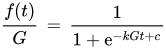
f ( t ) G = 1 1 + e − k G t + c {\displaystyle {\frac {f(t)}{G}}\,=\,{\frac {1}{1+\mathrm {e} ^{-kGt+c}}}} {\displaystyle {\frac {f(t)}{G}}\,=\,{\frac {1}{1+\mathrm {e} ^{-kGt+c}}}}

und daraus

( ∗ ∗ ) f ( t ) = G ⋅ 1 1 + e − k G t + c . {\displaystyle (**)\quad \quad \quad f(t)\,=\,G\cdot {\frac {1}{1+\mathrm {e} ^{-kGt+c}}}.} {\displaystyle (**)\quad \quad \quad f(t)\,=\,G\cdot {\frac {1}{1+\mathrm {e} ^{-kGt+c}}}.}

Setzen wir die Definition von c {\displaystyle c} {\displaystyle c} in die gefundene Lösung (**) ein, so kommen wir zur oben behaupteten Lösung der logistischen Differentialgleichung:

f ( t ) = G ⋅ 1 1 + e − k G t + c = G ⋅ 1 1 + e − k G t e c = G ⋅ 1 1 + e − k G t ( G f ( 0 ) − 1 ) . {\displaystyle f(t)\,=\,G\cdot {\frac {1}{1+\mathrm {e} ^{-kGt+c}}}\,=\,G\cdot {\frac {1}{1+\mathrm {e} ^{-kGt}\mathrm {e} ^{c}}}\,=\,G\cdot {\frac {1}{1+\mathrm {e} ^{-kGt}\left({\frac {G}{f(0)}}-1\right)}}.} {\displaystyle f(t)\,=\,G\cdot {\frac {1}{1+\mathrm {e} ^{-kGt+c}}}\,=\,G\cdot {\frac {1}{1+\mathrm {e} ^{-kGt}\mathrm {e} ^{c}}}\,=\,G\cdot {\frac {1}{1+\mathrm {e} ^{-kGt}\left({\frac {G}{f(0)}}-1\right)}}.}

An dieser Funktionsgleichung liest man leicht ab, dass die Werte immer zwischen 0 {\displaystyle 0} {\displaystyle 0} und G {\displaystyle G} {\displaystyle G} liegen, weshalb die Lösung für alle − ∞ < t < ∞ {\displaystyle -\infty <t<\infty } {\displaystyle -\infty <t<\infty } gilt. Das kann man im Nachhinein natürlich auch durch Einsetzen in die Differentialgleichung bestätigen.

Berechnung des Wendepunkts

[Bearbeiten | Quelltext bearbeiten]

Zur Bestimmung des Wendepunktes der Lösungsfunktion f {\displaystyle f} {\displaystyle f} bestimmen wir zunächst mittels Produktregel die Ableitungen

f ′ ( t ) = k ⋅ f ( t ) ⋅ ( G − f ( t ) ) f ″ ( t ) = k ⋅ f ′ ( t ) ⋅ ( G − f ( t ) ) + k ⋅ f ( t ) ⋅ ( − f ′ ( t ) ) = k ⋅ f ′ ( t ) ⋅ ( G − f ( t ) − f ( t ) ) = k ⋅ f ′ ( t ) ⋅ ( G − 2 ⋅ f ( t ) ) {\displaystyle {\begin{aligned}f'(t)&=k\cdot f(t)\cdot (G-f(t))\\f''(t)&=k\cdot f'(t)\cdot (G-f(t))+k\cdot f(t)\cdot (-f'(t))\\&=k\cdot f'(t)\cdot (G-f(t)-f(t))=k\cdot f'(t)\cdot (G-2\cdot f(t))\end{aligned}}} {\displaystyle {\begin{aligned}f'(t)&=k\cdot f(t)\cdot (G-f(t))\\f''(t)&=k\cdot f'(t)\cdot (G-f(t))+k\cdot f(t)\cdot (-f'(t))\\&=k\cdot f'(t)\cdot (G-f(t)-f(t))=k\cdot f'(t)\cdot (G-2\cdot f(t))\end{aligned}}}

und bestimmen die Nullstelle t W {\displaystyle t_{\mathrm {W} }} {\displaystyle t_{\mathrm {W} }} der zweiten Ableitung:

f ″ ( t W ) = k ⋅ f ′ ( t W ) ⋅ ( G − 2 ⋅ f ( t W ) ) = 0 {\displaystyle f''(t_{\mathrm {W} })=k\cdot f'(t_{\mathrm {W} })\cdot (G-2\cdot f(t_{\mathrm {W} }))=0} {\displaystyle f''(t_{\mathrm {W} })=k\cdot f'(t_{\mathrm {W} })\cdot (G-2\cdot f(t_{\mathrm {W} }))=0}
G − 2 ⋅ f ( t W ) = 0 {\displaystyle G-2\cdot f(t_{\mathrm {W} })=0} {\displaystyle G-2\cdot f(t_{\mathrm {W} })=0}
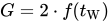
G = 2 ⋅ f ( t W ) {\displaystyle G=2\cdot f(t_{\mathrm {W} })} {\displaystyle G=2\cdot f(t_{\mathrm {W} })}
f ( t W ) = G 2 . {\displaystyle f(t_{\mathrm {W} })={\tfrac {G}{2}}.} {\displaystyle f(t_{\mathrm {W} })={\tfrac {G}{2}}.}

Damit kennen wir den Funktionswert im Wendepunkt und stellen fest, dass die Population im Wendepunkt gerade die halbe Sättigungsgrenze überschreitet. Zur Bestimmung von t W {\displaystyle t_{\mathrm {W} }} {\displaystyle t_{\mathrm {W} }} verwenden wir für f ( t W ) = G 2 {\displaystyle f(t_{\mathrm {W} })={\tfrac {G}{2}}} {\displaystyle f(t_{\mathrm {W} })={\tfrac {G}{2}}} die Lösungsformel und rechnen wie folgt:

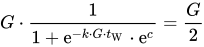
G ⋅ 1 1 + e − k ⋅ G ⋅ t W ⋅ e c = G 2 {\displaystyle G\cdot {\frac {1}{1+\mathrm {e} ^{-k\cdot G\cdot t_{\mathrm {W} }}\cdot \mathrm {e} ^{c}}}={\frac {G}{2}}} {\displaystyle G\cdot {\frac {1}{1+\mathrm {e} ^{-k\cdot G\cdot t_{\mathrm {W} }}\cdot \mathrm {e} ^{c}}}={\frac {G}{2}}}
1 + e − k ⋅ G ⋅ t W ⋅ e c = 2 {\displaystyle 1+\mathrm {e} ^{-k\cdot G\cdot t_{\mathrm {W} }}\cdot \mathrm {e} ^{c}=2} {\displaystyle 1+\mathrm {e} ^{-k\cdot G\cdot t_{\mathrm {W} }}\cdot \mathrm {e} ^{c}=2}
e − k ⋅ G ⋅ t W ⋅ e c = 1 = e 0 {\displaystyle \mathrm {e} ^{-k\cdot G\cdot t_{\mathrm {W} }}\cdot \mathrm {e} ^{c}=1=\mathrm {e} ^{0}} {\displaystyle \mathrm {e} ^{-k\cdot G\cdot t_{\mathrm {W} }}\cdot \mathrm {e} ^{c}=1=\mathrm {e} ^{0}}
− k ⋅ G ⋅ t W + c = 0 {\displaystyle -k\cdot G\cdot t_{\mathrm {W} }+c=0} {\displaystyle -k\cdot G\cdot t_{\mathrm {W} }+c=0}
t W = c k ⋅ G . {\displaystyle t_{\mathrm {W} }={\frac {c}{k\cdot G}}.} {\displaystyle t_{\mathrm {W} }={\frac {c}{k\cdot G}}.}

Für G > f ( 0 ) {\displaystyle \textstyle G>f(0)} {\displaystyle \textstyle G>f(0)} folgt mit e c = G f ( 0 ) − 1 ⇒ c = ln ⁡ ( G f ( 0 ) − 1 ) {\displaystyle \textstyle \mathrm {e} ^{c}={\frac {G}{f(0)}}-1\Rightarrow c=\ln \left({\frac {G}{f(0)}}-1\right)} {\displaystyle \textstyle \mathrm {e} ^{c}={\frac {G}{f(0)}}-1\Rightarrow c=\ln \left({\frac {G}{f(0)}}-1\right)} weiter:

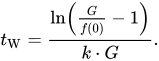
t W = ln ⁡ ( G f ( 0 ) − 1 ) k ⋅ G . {\displaystyle t_{\mathrm {W} }={\frac {\ln \left({\frac {G}{f(0)}}-1\right)}{k\cdot G}}.} {\displaystyle t_{\mathrm {W} }={\frac {\ln \left({\frac {G}{f(0)}}-1\right)}{k\cdot G}}.}

Damit ist der Wendepunkt vollständig bestimmt und es gibt nur diesen einen. Durch Einsetzen von f ( t W ) = G 2 {\displaystyle f(t_{\mathrm {W} })={\tfrac {G}{2}}} {\displaystyle f(t_{\mathrm {W} })={\tfrac {G}{2}}} in die erste Ableitung erhält man die maximale Wachstumsgeschwindigkeit:

f ′ ( t W ) = k ⋅ G 2 ⋅ ( G − G 2 ) = k ⋅ G 2 ⋅ G 2 {\displaystyle f'(t_{\mathrm {W} })=k\cdot {\frac {G}{2}}\cdot \left(G-{\frac {G}{2}}\right)=k\cdot {\frac {G}{2}}\cdot {\frac {G}{2}}} {\displaystyle f'(t_{\mathrm {W} })=k\cdot {\frac {G}{2}}\cdot \left(G-{\frac {G}{2}}\right)=k\cdot {\frac {G}{2}}\cdot {\frac {G}{2}}}
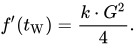
f ′ ( t W ) = k ⋅ G 2 4 . {\displaystyle f'(t_{\mathrm {W} })={\frac {k\cdot G^{2}}{4}}.} {\displaystyle f'(t_{\mathrm {W} })={\frac {k\cdot G^{2}}{4}}.}

Weitere Darstellungen

[Bearbeiten | Quelltext bearbeiten]

Aus

f ( t ) = G ⋅ 1 1 + e − k ⋅ G ⋅ t ( G f ( 0 ) − 1 ) {\displaystyle f(t)=G\cdot {\frac {1}{1+\mathrm {e} ^{-k\cdot G\cdot t}\left({\frac {G}{f(0)}}-1\right)}}} {\displaystyle f(t)=G\cdot {\frac {1}{1+\mathrm {e} ^{-k\cdot G\cdot t}\left({\frac {G}{f(0)}}-1\right)}}}

folgt:

f ( t ) = G ⋅ 1 1 + e − k ⋅ G ⋅ t ⋅ G f ( 0 ) − e − k ⋅ G ⋅ t ⋅ f ( 0 ) f ( 0 ) = G ⋅ f ( 0 ) f ( 0 ) + e − k ⋅ G ⋅ t ⋅ G − e − k ⋅ G ⋅ t ⋅ f ( 0 ) {\displaystyle f(t)=G\cdot {\frac {1}{1+\mathrm {e} ^{-k\cdot G\cdot t}\cdot {\frac {G}{f(0)}}-\mathrm {e} ^{-k\cdot G\cdot t}}}\cdot {\frac {f(0)}{f(0)}}={\frac {G\cdot f(0)}{f(0)+\mathrm {e} ^{-k\cdot G\cdot t}\cdot G-\mathrm {e} ^{-k\cdot G\cdot t}\cdot f(0)}}} {\displaystyle f(t)=G\cdot {\frac {1}{1+\mathrm {e} ^{-k\cdot G\cdot t}\cdot {\frac {G}{f(0)}}-\mathrm {e} ^{-k\cdot G\cdot t}}}\cdot {\frac {f(0)}{f(0)}}={\frac {G\cdot f(0)}{f(0)+\mathrm {e} ^{-k\cdot G\cdot t}\cdot G-\mathrm {e} ^{-k\cdot G\cdot t}\cdot f(0)}}}
= G ⋅ f ( 0 ) f ( 0 ) + ( G − f ( 0 ) ) ⋅ e − k ⋅ G ⋅ t {\displaystyle ={\frac {G\cdot f(0)}{f(0)+\left(G-f(0)\right)\cdot \mathrm {e} ^{-k\cdot G\cdot t}}}} {\displaystyle ={\frac {G\cdot f(0)}{f(0)+\left(G-f(0)\right)\cdot \mathrm {e} ^{-k\cdot G\cdot t}}}}

oder auch:

f ( t ) = G 2 ⋅ ( tanh ⁡ ( k G 2 ( t − t W ) ) + 1 ) {\displaystyle f(t)={\frac {G}{2}}\cdot \left(\tanh \left({\frac {kG}{2}}(t-t_{\mathrm {W} })\right)+1\right)} {\displaystyle f(t)={\frac {G}{2}}\cdot \left(\tanh \left({\frac {kG}{2}}(t-t_{\mathrm {W} })\right)+1\right)},

wobei t W {\displaystyle t_{\mathrm {W} }} {\displaystyle t_{\mathrm {W} }} die oben berechnete Wendestelle ist:

t W = ln ⁡ ( G f ( 0 ) − 1 ) k ⋅ G . {\displaystyle t_{\mathrm {W} }={\frac {\ln \left({\frac {G}{f(0)}}-1\right)}{k\cdot G}}.} {\displaystyle t_{\mathrm {W} }={\frac {\ln \left({\frac {G}{f(0)}}-1\right)}{k\cdot G}}.}

Umrechnung von stetigem exponentiellem in logistisches Wachstum

[Bearbeiten | Quelltext bearbeiten]

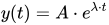
Oft werden Prognosen auf Basis von stetigem exponentiellem Wachstum angegeben (Wirtschaftswachstum, Infektionszahlen, Vermehrung). Diese Prognosen erweisen sich stets als unzutreffend, sobald der betrachtete Prozess in die Phase der Sättigung kommt. Spätestens dann ist es günstiger, das Modell „exponentielles Wachstum“ der Form y ( t ) = A ⋅ e λ ⋅ t {\displaystyle y(t)=A\cdot e^{\lambda \cdot t}} {\displaystyle y(t)=A\cdot e^{\lambda \cdot t}} durch das Modell „logistisches Wachstum“ zu ersetzen. Die Wachstumsfaktoren k {\displaystyle k} {\displaystyle k} der logistischen Funktion und λ {\displaystyle \lambda } {\displaystyle \lambda } der e-Funktion unterscheiden sich hier beträchtlich.

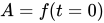
In allen Fällen werden zwei Punkte innerhalb der (vermeintlichen) exponentiellen Wachstumsphase benötigt. Hier wird davon ausgegangen, dass der erste Punkt bei A = f ( t = 0 ) {\displaystyle A=f(t=0)} {\displaystyle A=f(t=0)} liegt.

Da der zweite Punkt P ( T / Y ) {\displaystyle P(T/Y)} {\displaystyle P(T/Y)} in der exponentiellen Wachstumsphase liegt, gilt: G ≫ Y ⇒ G Y ≫ 1 ⇒ G Y − 1 ≈ G Y {\displaystyle G\gg Y\Rightarrow {\frac {G}{Y}}\gg 1\Rightarrow {\frac {G}{Y}}-1\approx {\frac {G}{Y}}} {\displaystyle G\gg Y\Rightarrow {\frac {G}{Y}}\gg 1\Rightarrow {\frac {G}{Y}}-1\approx {\frac {G}{Y}}}.

Damit gilt aus den ug. Formeln für λ {\displaystyle \lambda } {\displaystyle \lambda } und k {\displaystyle k} {\displaystyle k} näherungsweise: λ ≈ G A ⋅ k ⇔ k ≈ λ G A {\displaystyle \lambda \approx {\frac {G}{A}}\cdot k\Leftrightarrow k\approx {\frac {\lambda }{\frac {G}{A}}}} {\displaystyle \lambda \approx {\frac {G}{A}}\cdot k\Leftrightarrow k\approx {\frac {\lambda }{\frac {G}{A}}}}.

1. Fall: Verdopplung innerhalb des exponentiellen Wachstums

[Bearbeiten | Quelltext bearbeiten]

Liegt die Verdopplung des Anfangsbestandes in der Phase des exponentiellen Wachstums, vereinfacht das die Rechnung erheblich. Hier wird der wahre Anfangsbestand A {\displaystyle A} {\displaystyle A} normiert:

f ( 0 ) = 1 [ A ] {\displaystyle f(0)=1[A]} {\displaystyle f(0)=1[A]}; ebenso wird die Zeitachse auf den Verdopplungszeitraum t D {\displaystyle t_{D}} {\displaystyle t_{D}} normiert: f ( 1 [ t D ] ) = 2 [ A ] {\displaystyle f(1[t_{D}])=2[A]} {\displaystyle f(1[t_{D}])=2[A]}. Es ergibt sich eine Wachstumsfunktion mit λ = ln ⁡ f ( t D ) A = 1 = ln ⁡ ( 2 ) ≈ 0,693 {\displaystyle \lambda =\ln {\frac {f(t_{D})}{A=1}}=\ln \left(2\right)\approx 0{,}693} {\displaystyle \lambda =\ln {\frac {f(t_{D})}{A=1}}=\ln \left(2\right)\approx 0{,}693}:

y ( t / t D ) [ A ] = e ln ⁡ ( 2 ) ⋅ t | λ = ln ⁡ ( 2 ) {\displaystyle y(t/t_{D})[A]=e^{\ln \left(2\right)\cdot t}|\lambda =\ln \left(2\right)} {\displaystyle y(t/t_{D})[A]=e^{\ln \left(2\right)\cdot t}|\lambda =\ln \left(2\right)}

Als Nächstes wird eine Obergrenze G [ A ] {\displaystyle G[A]} {\displaystyle G[A]} als Vielfaches des Anfangsbestandes A {\displaystyle A} {\displaystyle A} festgelegt und der Verdopplungspunkt eingesetzt:

f ( t / t D ) [ A ] = 2 [ A ] = G ⋅ 1 1 + e − k ⋅ G ⋅ 1 [ t D ] ⋅ ( G A = 1 − 1 ) ⇔ e − k ⋅ G = G 2 [ A = 1 ] − 1 G − 1 ⇔ k = − ln ⁡ ( G 2 − 1 G − 1 ) G {\displaystyle {\begin{aligned}f(t/t_{D})[A]=2[A]&=G\cdot {\frac {1}{1+e^{-k\cdot G\cdot 1[t_{D}]}\cdot \left({\frac {G}{A=1}}-1\right)}}\\\Leftrightarrow e^{-k\cdot G}&={\frac {{\frac {G}{2[A=1]}}-1}{G-1}}\\\Leftrightarrow k&=-{\frac {\ln \left({\frac {{\frac {G}{2}}-1}{G-1}}\right)}{G}}\end{aligned}}} {\displaystyle {\begin{aligned}f(t/t_{D})[A]=2[A]&=G\cdot {\frac {1}{1+e^{-k\cdot G\cdot 1[t_{D}]}\cdot \left({\frac {G}{A=1}}-1\right)}}\\\Leftrightarrow e^{-k\cdot G}&={\frac {{\frac {G}{2[A=1]}}-1}{G-1}}\\\Leftrightarrow k&=-{\frac {\ln \left({\frac {{\frac {G}{2}}-1}{G-1}}\right)}{G}}\end{aligned}}}

Beispiel Obergrenze G = 100 ⋅ [ Anfangsbestand ] {\displaystyle G=100\cdot [{\textrm {Anfangsbestand}}]} {\displaystyle G=100\cdot [{\textrm {Anfangsbestand}}]}: λ = ln ⁡ ( 2 ) ≈ 0,696 3 k = − ln ⁡ 49 99 100 ≈ 0,007 033 λ k = 0,696 3 0,007 033 = 98,556 ≈ G [ A ] {\displaystyle {\begin{aligned}\lambda &=\ln(2)&\approx 0{,}6963\\k&=-{\frac {\ln {\frac {49}{99}}}{100}}&\approx 0{,}007033\\{\frac {\lambda }{k}}&={\frac {0{,}6963}{0{,}007033}}=98{,}556&\approx G[A]\end{aligned}}} {\displaystyle {\begin{aligned}\lambda &=\ln(2)&\approx 0{,}6963\\k&=-{\frac {\ln {\frac {49}{99}}}{100}}&\approx 0{,}007033\\{\frac {\lambda }{k}}&={\frac {0{,}6963}{0{,}007033}}=98{,}556&\approx G[A]\end{aligned}}}

2. Fall: Verdopplung außerhalb des exponentiellen Wachstums

[Bearbeiten | Quelltext bearbeiten]

Nur unwesentlich schwieriger wird der Fall, wenn die Verdopplungszeit schon außerhalb des exponentiellen Wachstums liegt; beispielsweise kann G = 2 {\displaystyle G=2} {\displaystyle G=2} sein. Damit ist der zweite Referenzpunkt P ( T | Y ) {\displaystyle P(T|Y)} {\displaystyle P(T|Y)} nicht mehr y ( t / [ t D ] ) = 2 [ A ] {\displaystyle y(t/[t_{D}])=2[A]} {\displaystyle y(t/[t_{D}])=2[A]}:

Y [ A ] = 1 [ A ] ⋅ e λ ⋅ T ⇔ λ = ln ⁡ Y A = 1 T = ln ⁡ ( Y ) T {\displaystyle {\begin{aligned}Y[A]&=1[A]\cdot e^{\lambda \cdot T}\\\Leftrightarrow \lambda &={\frac {\ln {\frac {Y}{A=1}}}{T}}={\frac {\ln(Y)}{T}}\end{aligned}}} {\displaystyle {\begin{aligned}Y[A]&=1[A]\cdot e^{\lambda \cdot T}\\\Leftrightarrow \lambda &={\frac {\ln {\frac {Y}{A=1}}}{T}}={\frac {\ln(Y)}{T}}\end{aligned}}}

Y [ A ] = G ⋅ 1 1 + e − k ⋅ G ⋅ T ⋅ ( G − 1 ) ⇔ e − k ⋅ G ⋅ T = G Y − 1 G − 1 ⇔ k = − ln ⁡ ( G Y − 1 G − 1 ) G ⋅ T {\displaystyle {\begin{aligned}Y[A]&=G\cdot {\frac {1}{1+e^{-k\cdot G\cdot T}\cdot \left(G-1\right)}}\\\Leftrightarrow e^{-k\cdot G\cdot T}&={\frac {{\frac {G}{Y}}-1}{G-1}}\\\Leftrightarrow k&=-{\frac {\ln \left({\frac {{\frac {G}{Y}}-1}{G-1}}\right)}{G\cdot T}}\end{aligned}}} {\displaystyle {\begin{aligned}Y[A]&=G\cdot {\frac {1}{1+e^{-k\cdot G\cdot T}\cdot \left(G-1\right)}}\\\Leftrightarrow e^{-k\cdot G\cdot T}&={\frac {{\frac {G}{Y}}-1}{G-1}}\\\Leftrightarrow k&=-{\frac {\ln \left({\frac {{\frac {G}{Y}}-1}{G-1}}\right)}{G\cdot T}}\end{aligned}}}

Zahlenbeispiel (extra krumme Zahlen):

Ein Kunde der FNORD-Bank legt einen Betrag von ln ⁡ ( 2 ) {\displaystyle \ln(2)} {\displaystyle \ln(2)} [ÖGE] (örtliche Geld-Einheiten) an. Er bekommt einen Kontoauszug, der nach e {\displaystyle e} {\displaystyle e} [NERD]-Zeiteinheiten einen Bestand von 2 {\displaystyle {\sqrt {2}}} {\displaystyle {\sqrt {2}}} [ÖGE] ausweist.

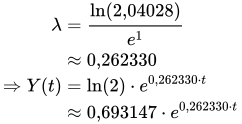
a) wie hoch ist der Faktor λ {\displaystyle \lambda } {\displaystyle \lambda } bei stetiger Verzinsung?
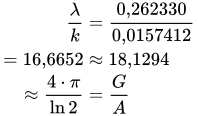
b) aus ethischen Gründen setzt die FNORD-Bank eine Obergrenze von 4 ⋅ π {\displaystyle 4\cdot \pi } {\displaystyle 4\cdot \pi } [ÖGE] je Konto und setzt die Verzinsung logistisch. Wie hoch ist jetzt der Faktor k {\displaystyle k} {\displaystyle k} der logistischen Funktion?
Lösung:

Der Kontostand zum Zeitpunkt T beträgt 2 ln ⁡ 2 ≈ 2,040 28 [ A ] {\displaystyle {\frac {\sqrt {2}}{\ln {2}}}\approx 2{,}04028[A]} {\displaystyle {\frac {\sqrt {2}}{\ln {2}}}\approx 2{,}04028[A]}

a)

λ = ln ⁡ ( 2,040 28 ) e 1 ≈ 0,262 330 ⇒ Y ( t ) = ln ⁡ ( 2 ) ⋅ e 0,262 330 ⋅ t ≈ 0,693 147 ⋅ e 0,262 330 ⋅ t {\displaystyle {\begin{aligned}\lambda &={\frac {\ln(2{,}04028)}{e^{1}}}\\&\approx 0{,}262330\\\Rightarrow Y(t)&=\ln(2)\cdot e^{0{,}262330\cdot t}\\&\approx 0{,}693147\cdot e^{0{,}262330\cdot t}\end{aligned}}} {\displaystyle {\begin{aligned}\lambda &={\frac {\ln(2{,}04028)}{e^{1}}}\\&\approx 0{,}262330\\\Rightarrow Y(t)&=\ln(2)\cdot e^{0{,}262330\cdot t}\\&\approx 0{,}693147\cdot e^{0{,}262330\cdot t}\end{aligned}}}

b)

Die Obergrenze beträgt 4 ⋅ π ln ⁡ 2 ≈ 18,129 4 ⋅ [ A ] {\displaystyle {\frac {4\cdot \pi }{\ln {2}}}\approx 18{,}1294\cdot [A]} {\displaystyle {\frac {4\cdot \pi }{\ln {2}}}\approx 18{,}1294\cdot [A]}

k = − ln ⁡ ( 18,129 4 2,040 28 − 1 18,129 4 − 1 ) 18,129 4 ⋅ e 1 ≈ 0,015 7412 ⇒ Y ( t ) = 4 π ⋅ 1 1 + e − 0,015 7412 ⋅ 4 π ⋅ t ⋅ ( 4 π l n ( 2 ) − 1 ) ≈ 12,566 44 ⋅ 1 1 + e − 0,015 7412 ⋅ 12,566 44 ⋅ t ⋅ ( 17,129 4 ) {\displaystyle {\begin{aligned}k&=-{\frac {\ln \left({\frac {{\frac {18{,}1294}{2{,}04028}}-1}{18{,}1294-1}}\right)}{18{,}1294\cdot e^{1}}}\\&\approx 0{,}0157412\\\Rightarrow Y(t)&=4\pi \cdot {\frac {1}{1+e^{-0{,}0157412\cdot 4\pi \cdot t}\cdot \left({\frac {4\pi }{ln(2)}}-1\right)}}\\&\approx 12{,}56644\cdot {\frac {1}{1+e^{-0{,}0157412\cdot 12{,}56644\cdot t}\cdot \left(17{,}1294\right)}}\end{aligned}}} {\displaystyle {\begin{aligned}k&=-{\frac {\ln \left({\frac {{\frac {18{,}1294}{2{,}04028}}-1}{18{,}1294-1}}\right)}{18{,}1294\cdot e^{1}}}\\&\approx 0{,}0157412\\\Rightarrow Y(t)&=4\pi \cdot {\frac {1}{1+e^{-0{,}0157412\cdot 4\pi \cdot t}\cdot \left({\frac {4\pi }{ln(2)}}-1\right)}}\\&\approx 12{,}56644\cdot {\frac {1}{1+e^{-0{,}0157412\cdot 12{,}56644\cdot t}\cdot \left(17{,}1294\right)}}\end{aligned}}}


λ k = 0,262 330 0,015 7412 = 16,665 2 ≈ 18,129 4 ≈ 4 ⋅ π ln ⁡ 2 = G A {\displaystyle {\begin{aligned}{\frac {\lambda }{k}}&={\frac {0{,}262330}{0{,}0157412}}\\=16{,}6652&\approx 18{,}1294\\\approx {\frac {4\cdot \pi }{\ln {2}}}&={\frac {G}{A}}\end{aligned}}} {\displaystyle {\begin{aligned}{\frac {\lambda }{k}}&={\frac {0{,}262330}{0{,}0157412}}\\=16{,}6652&\approx 18{,}1294\\\approx {\frac {4\cdot \pi }{\ln {2}}}&={\frac {G}{A}}\end{aligned}}}

Siehe auch

[Bearbeiten | Quelltext bearbeiten]
  • Logistische Regression
  • SI-Modell

Literatur

[Bearbeiten | Quelltext bearbeiten]
  • Nicholas F. Britton: Essential Mathematical Biology. 3. printing. Springer, London u. a. 2005, ISBN 1-85233-536-X, (Springer undergraduate mathematics series).
  • Norman R. Draper, Harry Smith: Applied Regression Analysis. 3rd Edition. Wiley-Interscience, New York NY u. a. 1998, ISBN 0-471-17082-8, (Wiley Series in Probability and Statistics. Texts and References Section).
  • Volker Oppitz, Volker Nollau: Taschenbuch Wirtschaftlichkeitsrechnung. Quantitative Methoden der ökonomischen Analyse. Carl Hanser Verlag, München u. a. 2004, ISBN 3-446-22463-7.
  • Volker Oppitz: Gabler-Lexikon Wirtschaftlichkeitsrechnung. Mit Anwendersoftware für Praxis und Studium. Gabler-Verlag Wiesbaden 1995, ISBN 3-409-19951-9.
  • Peter Schönfeld: Methoden der Ökonometrie. 2 Bände. Vahlen, Berlin u. a. 1969–1971.

Einzelnachweise

[Bearbeiten | Quelltext bearbeiten]
  1. ↑ John C. Fisher, Robert H. Pry: A Simple Substitution Model of Technological Change. In: Technological Forecasting and Social Change. Band 3. Elsevier, 1971, ISSN 0040-1625, S. 75–88, doi:10.1016/S0040-1625(71)80005-7 (ucsd.edu [PDF]): „The fractional rate of fractional substitution of new for old is proportional to the remaining amount of the old left to be substituted. [..] can be derived from our third assumption, which in mathematical form is ( 1 / f )   d f / d t = 2   α ( 1 − f ) {\textstyle (1/f)\ df/dt=2\ \alpha (1-f)} {\textstyle (1/f)\ df/dt=2\ \alpha (1-f)}. [where α {\displaystyle \alpha } {\displaystyle \alpha } is half the annual fractional growth in the early years]“ 
Abgerufen von „https://de.teknopedia.teknokrat.ac.id/w/index.php?title=Logistische_Funktion&oldid=258450298“

Kategorien:
  • Mathematische Funktion
  • Theoretische Biologie
  • Biostatistik
  • Regressionsanalyse

  • indonesia
  • Polski
  • العربية
  • Deutsch
  • English
  • Español
  • Français
  • Italiano
  • مصرى
  • Nederlands
  • 日本語
  • Português
  • Sinugboanong Binisaya
  • Svenska
  • Українська
  • Tiếng Việt
  • Winaray
  • 中文
  • Русский
Sunting pranala
Pusat Layanan

UNIVERSITAS TEKNOKRAT INDONESIA | ASEAN's Best Private University
Jl. ZA. Pagar Alam No.9 -11, Labuhan Ratu, Kec. Kedaton, Kota Bandar Lampung, Lampung 35132
Phone: (0721) 702022
Email: pmb@teknokrat.ac.id