Technopedia Center
PMB University Brochure
Faculty of Engineering and Computer Science
S1 Informatics S1 Information Systems S1 Information Technology S1 Computer Engineering S1 Electrical Engineering S1 Civil Engineering

faculty of Economics and Business
S1 Management S1 Accountancy

Faculty of Letters and Educational Sciences
S1 English literature S1 English language education S1 Mathematics education S1 Sports Education
  • Registerasi
  • Brosur UTI
  • Kip Scholarship Information
  • Performance
  1. Weltenzyklopädie
  2. Lineare Funktion – Wikipedia
Lineare Funktion – Wikipedia 👆 Click Here!
aus Wikipedia, der freien Enzyklopädie
Dieser Artikel behandelt die Funktionen in der elementaren Analysis. Für lineare Funktionen in der linearen Algebra siehe Lineare Abbildung.

Unter einer linearen Funktion versteht man oft (insbesondere in der Schulmathematik) eine Funktion f : R → R {\displaystyle f\colon \mathbb {R} \to \mathbb {R} } {\displaystyle f\colon \mathbb {R} \to \mathbb {R} }, die sich in der Form

f ( x ) = m ⋅ x + n {\displaystyle f(x)=m\cdot x+n} {\displaystyle f(x)=m\cdot x+n}

mit m , n ∈ R {\displaystyle m,n\in \mathbb {R} } {\displaystyle m,n\in \mathbb {R} } schreiben lässt.[1][2] Es handelt sich um eine Polynomfunktion höchstens ersten Grades. Der Graph einer linearen Funktion ist eine Gerade, wodurch sich der Name ableitet (von lateinisch linea ‚(gerade) Linie‘).

Eine lineare Funktion im oben beschriebenen Sinne ist keine lineare Abbildung im Sinne der linearen Algebra, da die Linearitätsbedingung im Allgemeinen nicht erfüllt ist. Vielmehr handelt es sich um eine affine Abbildung, weshalb man auch von einer affin-linearen Funktion[3] spricht. Um eine lineare Abbildung im Sinne der linearen Algebra handelt es sich nur im Spezialfall n = 0 {\displaystyle n=0} {\displaystyle n=0}, also f ( x ) = m x . {\displaystyle f(x)=mx.} {\displaystyle f(x)=mx.} Solche Funktionen werden auch als homogene lineare Funktion oder Proportionalität bezeichnet. In Anlehnung an diese Bezeichnung wird die Funktion für den Fall n ≠ 0 {\displaystyle n\neq 0} {\displaystyle n\neq 0} auch linear-inhomogene Funktion genannt.

Lineare Funktionen gehören zu den grundlegenden Funktionen in der Mathematik. Sie sind stetig und differenzierbar. Viele Probleme lassen sich mithilfe linearer Funktionen leichter lösen; daher versucht man oft, komplizierte Zusammenhänge durch lineare Funktionen zu approximieren.

Graph

[Bearbeiten | Quelltext bearbeiten]
Steigungsdreiecke am Graph der linearen Funktion x ↦ 1 2 x + 2 {\displaystyle x\mapsto {\tfrac {1}{2}}x+2} {\displaystyle x\mapsto {\tfrac {1}{2}}x+2}

Der Graph einer linearen Funktion ist eine Gerade. In kartesischen Koordinaten ( x | y ) {\displaystyle (x|y)} {\displaystyle (x|y)} gilt

y = m ⋅ x + n {\displaystyle y=m\cdot x+n} {\displaystyle y=m\cdot x+n}

mit reellen Zahlen m {\displaystyle m} {\displaystyle m} und n , {\displaystyle n,} {\displaystyle n,} wobei x {\displaystyle x} {\displaystyle x} (die Abszisse) die unabhängige und y {\displaystyle y} {\displaystyle y} (die Ordinate) die abhängige Variable ist. Die Bezeichnung der beiden Konstanten mit m {\displaystyle m} {\displaystyle m} und n {\displaystyle n} {\displaystyle n} ist beliebig, in der Literatur finden sich zahlreiche andere Bezeichnungsweisen.

Diese Darstellung bezeichnet man auch als die Normalform einer linearen Funktion. Ihre zwei Parameter lassen sich wie folgt interpretieren:

  • Die Zahl m {\displaystyle m} {\displaystyle m} gibt die Steigung der Geraden an.
  • Die Zahl n {\displaystyle n} {\displaystyle n} ist der y-Achsen- oder Ordinatenabschnitt, die Inhomogenität oder die Verschiebungskonstante.

Der Graph einer linearen Funktion verläuft nie parallel zur y {\displaystyle y} {\displaystyle y}-Achse, da damit einem x {\displaystyle x} {\displaystyle x}-Wert mehr als ein y {\displaystyle y} {\displaystyle y}-Wert zugeordnet wäre, was in Widerspruch zur definitorisch geforderten (Rechts-)Eindeutigkeit einer Funktion stünde.

Bestimmung des Funktionsterms aus zwei Punkten

[Bearbeiten | Quelltext bearbeiten]
Steigung einer linearen Funktion durch zwei gegebene Punkte

Es wird vorausgesetzt, dass die Punkte ( x 1 | y 1 ) {\displaystyle (x_{1}|y_{1})} {\displaystyle (x_{1}|y_{1})} und ( x 2 | y 2 ) {\displaystyle (x_{2}|y_{2})} {\displaystyle (x_{2}|y_{2})} auf dem Graphen der linearen Funktion f {\displaystyle f} {\displaystyle f} liegen und voneinander verschieden sind.

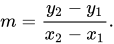
Die Steigung m {\displaystyle m} {\displaystyle m} lässt sich berechnen mit

m = y 2 − y 1 x 2 − x 1 . {\displaystyle m={\frac {y_{2}-y_{1}}{x_{2}-x_{1}}}.} {\displaystyle m={\frac {y_{2}-y_{1}}{x_{2}-x_{1}}}.}

Der y-Achsenabschnitt n {\displaystyle n} {\displaystyle n} ergibt sich mit

n = y 1 − m ⋅ x 1 {\displaystyle n=y_{1}-m\cdot x_{1}} {\displaystyle n=y_{1}-m\cdot x_{1}} oder n = y 2 − m ⋅ x 2 . {\displaystyle n=y_{2}-m\cdot x_{2}.} {\displaystyle n=y_{2}-m\cdot x_{2}.}

Der gesuchte Funktionsterm f ( x ) {\displaystyle f(x)} {\displaystyle f(x)} ist also gegeben durch

f ( x ) = y 2 − y 1 x 2 − x 1 ⋅ x + ( y 1 − y 2 − y 1 x 2 − x 1 ⋅ x 1 ) {\displaystyle f(x)={\frac {y_{2}-y_{1}}{x_{2}-x_{1}}}\cdot x+\left(y_{1}-{\frac {y_{2}-y_{1}}{x_{2}-x_{1}}}\cdot x_{1}\right)} {\displaystyle f(x)={\frac {y_{2}-y_{1}}{x_{2}-x_{1}}}\cdot x+\left(y_{1}-{\frac {y_{2}-y_{1}}{x_{2}-x_{1}}}\cdot x_{1}\right)}

oder kürzer durch

f ( x ) = y 2 − y 1 x 2 − x 1 ⋅ ( x − x 1 ) + y 1 . {\displaystyle f(x)={\frac {y_{2}-y_{1}}{x_{2}-x_{1}}}\cdot (x-x_{1})+y_{1}.} {\displaystyle f(x)={\frac {y_{2}-y_{1}}{x_{2}-x_{1}}}\cdot (x-x_{1})+y_{1}.}

Zusammenfassung

[Bearbeiten | Quelltext bearbeiten]

Funktionsgleichung

[Bearbeiten | Quelltext bearbeiten]
Eine Funktion f {\displaystyle f} {\displaystyle f} mit f ( x ) = m x + n {\displaystyle f(x)=mx+n} {\displaystyle f(x)=mx+n} heißt lineare Funktion. Im Fall m ≠ 0 {\displaystyle m\neq 0} {\displaystyle m\neq 0} wird „ganzrationale Funktion 1. Grades“ oder „Polynom 1. Grades“ als Bezeichnung verwendet.
Die graphische Darstellung des Funktionsgraphen ist eine Gerade.

Achsenschnittpunkte

[Bearbeiten | Quelltext bearbeiten]
Schnittpunkt P {\displaystyle P} {\displaystyle P} mit der x {\displaystyle x} {\displaystyle x}-Achse: P ( x P | 0 ) ⇒ f ( x P ) = 0 {\displaystyle P(x_{P}|0)\Rightarrow f(x_{P})=0} {\displaystyle P(x_{P}|0)\Rightarrow f(x_{P})=0}
Schnittpunkt Q {\displaystyle Q} {\displaystyle Q} mit der y {\displaystyle y} {\displaystyle y}-Achse: Q ( 0 | y Q ) ⇒ y Q = f ( 0 ) {\displaystyle Q(0|y_{Q})\Rightarrow y_{Q}=f(0)} {\displaystyle Q(0|y_{Q})\Rightarrow y_{Q}=f(0)}

Steigung

[Bearbeiten | Quelltext bearbeiten]

Die Steigung tan ⁡ α {\displaystyle \tan \alpha } {\displaystyle \tan \alpha } des Graphen einer linearen Funktion f {\displaystyle f} {\displaystyle f} lässt sich wegen tan ⁡ α = m {\displaystyle \tan \alpha =m} {\displaystyle \tan \alpha =m} vom Koeffizienten in der Funktionsgleichung f ( x ) = m x + n {\displaystyle f(x)=mx+n} {\displaystyle f(x)=mx+n} ablesen.

Aus den Koordinaten zweier Punkte der Geraden wird sie so berechnet:

tan ⁡ α = f ( x 2 ) − f ( x 1 ) x 2 − x 1 = y 2 − y 1 x 2 − x 1 = Δ y Δ x {\displaystyle \tan \alpha ={\frac {f(x_{2})-f(x_{1})}{x_{2}-x_{1}}}={\frac {y_{2}-y_{1}}{x_{2}-x_{1}}}={\frac {\Delta y}{\Delta x}}} {\displaystyle \tan \alpha ={\frac {f(x_{2})-f(x_{1})}{x_{2}-x_{1}}}={\frac {y_{2}-y_{1}}{x_{2}-x_{1}}}={\frac {\Delta y}{\Delta x}}}

Funktionsgleichung aufstellen

[Bearbeiten | Quelltext bearbeiten]
  • Die Steigung m {\displaystyle m} {\displaystyle m} und ein Punkt P 1 ( x 1 | y 1 ) , {\displaystyle P_{1}(x_{1}|y_{1}),} {\displaystyle P_{1}(x_{1}|y_{1}),} der auf der Geraden liegt, seien bekannt.
Ansatz: f ( x ) = m x + n {\displaystyle f(x)=mx+n} {\displaystyle f(x)=mx+n}
P 1 ( x 1 | y 1 ) ⇒ f ( x 1 ) = y 1 ⇒ m x 1 + n = y 1 ⇒ n = y 1 − m x 1 {\displaystyle P_{1}(x_{1}|y_{1})\quad \Rightarrow \quad f(x_{1})=y_{1}\quad \Rightarrow \quad mx_{1}+n=y_{1}\quad \Rightarrow \quad n=y_{1}-mx_{1}} {\displaystyle P_{1}(x_{1}|y_{1})\quad \Rightarrow \quad f(x_{1})=y_{1}\quad \Rightarrow \quad mx_{1}+n=y_{1}\quad \Rightarrow \quad n=y_{1}-mx_{1}}
  • Die Koordinaten zweier Punkte P 1 ( x 1 | y 1 ) {\displaystyle P_{1}(x_{1}|y_{1})} {\displaystyle P_{1}(x_{1}|y_{1})} und P 2 ( x 2 | y 2 ) , {\displaystyle P_{2}(x_{2}|y_{2}),} {\displaystyle P_{2}(x_{2}|y_{2}),} die auf der Geraden liegen, seien bekannt.
Zuerst wird der Steigungsfaktor m = y 2 − y 1 x 2 − x 1 {\displaystyle m={\frac {y_{2}-y_{1}}{x_{2}-x_{1}}}} {\displaystyle m={\frac {y_{2}-y_{1}}{x_{2}-x_{1}}}} berechnet, dann damit n {\displaystyle n} {\displaystyle n}:
P 1 ( x 1 | y 1 ) ⇒ f ( x 1 ) = y 1 ⇒ m x 1 + n = y 1 ⇒ n = y 1 − m x 1 {\displaystyle P_{1}(x_{1}|y_{1})\quad \Rightarrow \quad f(x_{1})=y_{1}\quad \Rightarrow \quad mx_{1}+n=y_{1}\quad \Rightarrow \quad n=y_{1}-mx_{1}} {\displaystyle P_{1}(x_{1}|y_{1})\quad \Rightarrow \quad f(x_{1})=y_{1}\quad \Rightarrow \quad mx_{1}+n=y_{1}\quad \Rightarrow \quad n=y_{1}-mx_{1}}
oder
P 2 ( x 2 | y 2 ) ⇒ f ( x 2 ) = y 2 ⇒ m x 2 + n = y 2 ⇒ n = y 2 − m x 2 {\displaystyle P_{2}(x_{2}|y_{2})\quad \Rightarrow \quad f(x_{2})=y_{2}\quad \Rightarrow \quad mx_{2}+n=y_{2}\quad \Rightarrow \quad n=y_{2}-mx_{2}} {\displaystyle P_{2}(x_{2}|y_{2})\quad \Rightarrow \quad f(x_{2})=y_{2}\quad \Rightarrow \quad mx_{2}+n=y_{2}\quad \Rightarrow \quad n=y_{2}-mx_{2}}

Schnittpunkt zweier Geraden

[Bearbeiten | Quelltext bearbeiten]

Schneiden sich zwei durch f ( x ) {\displaystyle f(x)} {\displaystyle f(x)} und g ( x ) {\displaystyle g(x)} {\displaystyle g(x)} beschriebene Geraden, so muss im Schnittpunkt die Bedingung

f ( x ) = g ( x ) {\displaystyle f(x)=g(x)} {\displaystyle f(x)=g(x)}

erfüllt sein. Die Lösung x S {\displaystyle x_{S}} {\displaystyle x_{S}} dieser Gleichung ist die x {\displaystyle x} {\displaystyle x}-Koordinate des Schnittpunktes und y S = f ( x S ) = g ( x S ) {\displaystyle y_{S}=f(x_{S})=g(x_{S})} {\displaystyle y_{S}=f(x_{S})=g(x_{S})} seine y {\displaystyle y} {\displaystyle y}-Koordinate.

Orthogonale Geraden

[Bearbeiten | Quelltext bearbeiten]
Für die Steigungen m 1 {\displaystyle m_{1}} {\displaystyle m_{1}} und m 2 {\displaystyle m_{2}} {\displaystyle m_{2}} zweier senkrecht aufeinander stehender Geraden g 1 {\displaystyle g_{1}} {\displaystyle g_{1}} und g 2 {\displaystyle g_{2}} {\displaystyle g_{2}} gilt:
m 1 ⋅ m 2 = − 1 {\displaystyle m_{1}\cdot m_{2}=-1} {\displaystyle m_{1}\cdot m_{2}=-1}
m 1 = − 1 m 2 {\displaystyle m_{1}=-{\frac {1}{m_{2}}}} {\displaystyle m_{1}=-{\frac {1}{m_{2}}}}
m 2 = − 1 m 1 {\displaystyle m_{2}=-{\frac {1}{m_{1}}}} {\displaystyle m_{2}=-{\frac {1}{m_{1}}}}

Ableitung und Stammfunktion

[Bearbeiten | Quelltext bearbeiten]

Die Ableitung einer linearen Funktion f ( x ) = m x + n {\displaystyle f\left(x\right)=mx+n} {\displaystyle f\left(x\right)=mx+n} ist f ′ ( x ) = m {\displaystyle f'\left(x\right)=m} {\displaystyle f'\left(x\right)=m}, also eine konstante Funktion.

Stammfunktionen von f {\displaystyle f} {\displaystyle f} haben die Gestalt F ( x ) = m 2 x 2 + n x + c {\displaystyle F(x)={\frac {m}{2}}x^{2}+nx+c} {\displaystyle F(x)={\frac {m}{2}}x^{2}+nx+c}. Für m ≠ 0 {\displaystyle m\neq 0} {\displaystyle m\neq 0} handelt es sich um quadratische Funktionen, für m = 0 {\displaystyle m=0} {\displaystyle m=0} um lineare Funktionen.

Verhalten im Unendlichen

[Bearbeiten | Quelltext bearbeiten]

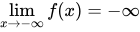
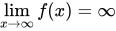
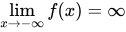
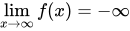
Ist der Steigungsparameter m {\displaystyle m} {\displaystyle m} einer linearen Funktion f ( x ) {\displaystyle f(x)} {\displaystyle f(x)} positiv, so gilt lim x → − ∞ f ( x ) = − ∞ {\displaystyle \lim _{x\to -\infty }f(x)=-\infty } {\displaystyle \lim _{x\to -\infty }f(x)=-\infty } und lim x → ∞ f ( x ) = ∞ {\displaystyle \lim _{x\to \infty }f(x)=\infty } {\displaystyle \lim _{x\to \infty }f(x)=\infty }. Ist m {\displaystyle m} {\displaystyle m} negativ, so gilt umgekehrt lim x → − ∞ f ( x ) = ∞ {\displaystyle \lim _{x\to -\infty }f(x)=\infty } {\displaystyle \lim _{x\to -\infty }f(x)=\infty } und lim x → ∞ f ( x ) = − ∞ {\displaystyle \lim _{x\to \infty }f(x)=-\infty } {\displaystyle \lim _{x\to \infty }f(x)=-\infty }. Beim Sonderfall m = 0 {\displaystyle m=0} {\displaystyle m=0} liegt eine konstante Funktion vor und es gilt lim x → − ∞ f ( x ) = lim x → ∞ f ( x ) = n {\displaystyle \lim _{x\to -\infty }f(x)=\lim _{x\to \infty }f(x)=n} {\displaystyle \lim _{x\to -\infty }f(x)=\lim _{x\to \infty }f(x)=n}.

Lineare Funktionen mehrerer Veränderlicher

[Bearbeiten | Quelltext bearbeiten]

Eine (affin) lineare Funktion zweier Veränderlicher x {\displaystyle x} {\displaystyle x} und y {\displaystyle y} {\displaystyle y} ist eine Funktion f : R 2 → R {\displaystyle f\colon \mathbb {R} ^{2}\to \mathbb {R} } {\displaystyle f\colon \mathbb {R} ^{2}\to \mathbb {R} }, die sich in der Form

f ( x , y ) = a x + b y + c {\displaystyle f(x,y)=ax+by+c} {\displaystyle f(x,y)=ax+by+c}

mit a , b , c ∈ R {\displaystyle a,b,c\in \mathbb {R} } {\displaystyle a,b,c\in \mathbb {R} } schreiben lässt. Es handelt sich um eine bivariate Polynomfunktion höchstens ersten Grades. Der Graph linearen Funktion zweier Veränderlicher ist eine Ebene.

Allgemein ist eine (affin) lineare Funktion mehrerer Veränderlicher x 1 , … x n {\displaystyle x_{1},\ldots x_{n}} {\displaystyle x_{1},\ldots x_{n}} eine Funktion f : R n → R {\displaystyle f\colon \mathbb {R} ^{n}\to \mathbb {R} } {\displaystyle f\colon \mathbb {R} ^{n}\to \mathbb {R} }, die sich in der Form

f ( x 1 , … , x n ) = a 1 x 1 + ⋯ + a n x n + c {\displaystyle f(x_{1},\ldots ,x_{n})=a_{1}x_{1}+\cdots +a_{n}x_{n}+c} {\displaystyle f(x_{1},\ldots ,x_{n})=a_{1}x_{1}+\cdots +a_{n}x_{n}+c}

mit a 1 , … , a n , c ∈ R {\displaystyle a_{1},\ldots ,a_{n},c\in \mathbb {R} } {\displaystyle a_{1},\ldots ,a_{n},c\in \mathbb {R} } schreiben lässt.[4] Der Graph einer solchen Funktion ist eine Hyperebene.

Weblinks

[Bearbeiten | Quelltext bearbeiten]
Commons: Lineare Gleichungen – Sammlung von Bildern
Commons: Lineare Funktionen – Sammlung von Bildern, Videos und Audiodateien
Wikibooks: M A T H E μ α T R i x {\displaystyle {\begin{smallmatrix}{\mathbf {MATHE} \mu \alpha T\mathbb {R} ix}\end{smallmatrix}}} {\displaystyle {\begin{smallmatrix}{\mathbf {MATHE} \mu \alpha T\mathbb {R} ix}\end{smallmatrix}}}: Mathematik für die Schule
  • Lineare Funktionen – Einführung für Schüler (Video)

Literatur

[Bearbeiten | Quelltext bearbeiten]
  • Manfred Leppig: Lernstufen Mathematik. Girardet 1981, ISBN 3-7736-2005-5, S. 61–74. 

Einzelnachweise

[Bearbeiten | Quelltext bearbeiten]
  1. ↑ Duden (Hrsg.): Basiswissen Schule Mathematik. 4. Auflage. 2010, ISBN 978-3-411-71504-6, S. 180. 
  2. ↑ Bärbel Barzel, Matthias Glade, Marcel Klinger: Algebra und Funktionen: Fachlich und fachdidaktisch. 1. Auflage. Springer, Berlin, Heidelberg 2021, ISBN 978-3-662-61392-4, S. 118. 
  3. ↑ Tilo Arens, Frank Hettlich, Christian Karpfinger, Ulrich Kockelkorn, Klaus Lichtenegger, Hellmuth Stachel: Mathematik. 5. Auflage. Springer, 2022, ISBN 978-3-662-64388-4, S. 104. 
  4. ↑ Steffen Timmann: Repetitorium der Analysis Teil 2. 2. Auflage. Binomi-Verlag, Hannover 2006, ISBN 978-3-923923-52-6, S. 38. 
Normdaten (Sachbegriff): GND: 4744418-6 (GND Explorer, lobid, OGND, AKS)
Abgerufen von „https://de.teknopedia.teknokrat.ac.id/w/index.php?title=Lineare_Funktion&oldid=258994135“
Kategorien:
  • Lineare Algebra
  • Analysis
  • Mathematische Funktion
  • Normalform

  • indonesia
  • Polski
  • العربية
  • Deutsch
  • English
  • Español
  • Français
  • Italiano
  • مصرى
  • Nederlands
  • 日本語
  • Português
  • Sinugboanong Binisaya
  • Svenska
  • Українська
  • Tiếng Việt
  • Winaray
  • 中文
  • Русский
Sunting pranala
Pusat Layanan

UNIVERSITAS TEKNOKRAT INDONESIA | ASEAN's Best Private University
Jl. ZA. Pagar Alam No.9 -11, Labuhan Ratu, Kec. Kedaton, Kota Bandar Lampung, Lampung 35132
Phone: (0721) 702022
Email: pmb@teknokrat.ac.id